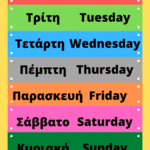

So, you have decided that you want to learn Greek.
You’re likely excited, but you might also feel threatened by this new challenge. In fact, you’ve probably heard that Greek is not an easy language. Because of this, you’re starting to feel intimidated?
Well, it’s time to relax. Even though I’m not going to sugar-coat it, I can tell you that it’s not so difficult either. As a matter of fact, it just needs persistence and dedication.
Above all, the key to success is practice. But apart from that, I’m going to share these 10 Clever Tips to Help You Learn Greek to make your journey easier.
Shall we get started?
Tips to Help You Learn Greek

1. Learn the right phrases for you
Every language has tons of vocabulary.
But think about it. Do you need to learn phrases or words that you hardly gonna use? Of course, the answer is no.
Instead of wasting energy on things you won’t use, start with phrases you need daily.
Learning things that are not really useful for you – at least at the beginning – is gonna make your road harder to walk through. Don’t waste energy in things that you are not really going to use.
It will confuse you and probably will make difficult to remember things that you should. So, start with phrases that you frequently use. Stick with them, memorize them, use them and then move on to the next level.
As a result, this will give you more confidence. And it will also keeps you motivated to move on to the next level
2. Learn cognates, the secret to learn Greek
Did you know that you already can speak Greek?
According to the British council, over 150,000 English words are derived from the Greek language. This is a huge number and I’m pretty sure you have been using Greek without even knowing it!
But this is good for you because now you can make a list – a huge one – with Greek words that you already know. I will write a separate post about the connection between English and Greek and I intend to give a lot of examples.
For now, you can watch the video I have made which include many English words of Greek origin.
3. Set small goals
Before you even start, ask yourself why you want to learn Greek. This is an important question you need to ask because it will help you understand what is important for you to learn and how to learn it.
For instance, do you want to learn Greek because you’re planning to take a trip to Greece and now you’re overwhelmed because you need to know all Greek related to greetings, traveling, booking, how to shop, how to order etc?
If so, don’t rush to learn everything at once because chances are you will end up remembering nothing in the end. Instead, set small goals.
For instance, start learn greetings first. Once you’ve learned them then move on to your next goal. By doing this, will help you boost your confidence with the language but also will help you complete them easily and quicker.
This also applies in life in general. Setting big goals can bring you anxiety and the sentiment of disappointment if you fail to complete it.
Separating a big goal into smaller ones that you can easily complete it will help you reach smoother to your biggest goal.
4. If you want to learn Greek, you need to use Greek as often as possible
In other words, read, watch, and listen in Greek.
You have started learning Greek. For instance, you might study grammar and vocabulary and still feel it’s not enough. In fact, you’re probably right!
In order to “feel” the Greek – or any other language – you need to use it frequently. And how can you do that? As I stated above, by reading, watching and listening in Greek.
But let’s analyze this a bit.
Read in Greek
Ok, I’m not going to say, start reading Greek literature, but you can start by reading smaller things like fairy tales. You can start with classic fairy tales which you’re already familiar with, but this time try to read it in Greek.
If you already know the story then you will be able to understand better the new words you’re going to see. Then you can move on to Greek fairy tales.
Aesop’s fables will be a good start.
Read Greek comics. Comics with images and little Greek phrases in the bulletins is perfect for a relax reading as a beginner.
Read articles in Greek. Luckily with the internet, you can find any kind of article.
Do you like cooking?
There are plenty of recipes in Greek.
Do you like sports?
Then start reading sport news in Greek!
Watch in Greek
You’re relaxed at home and you plan to watch a movie. Why don’t you practice some Greek at the same time? How? By adding Greek subtitles to the movie.
You can also watch Greek movies with subtitles in your native language and once you get familiar with this technique or as you getting advanced in Greek, you can also start watching Greek movies with Greek subtitles or no subtitles at all.
This is a great and a fun way to build up your vocabulary.
Listen in Greek
You have just woken up. You’re getting out of the shower and you’re about to make coffee. You turn on the radio to listen to your favorite music as you drink your coffee.
But wait a minute.
You’re also learning Greek. Why don’t you stream instead a Greek radio station or search YouTube for some Greek music?
Not a bad idea you think and suddenly your mornings have a Greek flavor. This applies to all hours during a day. No problem!
5. To learn Greek, try to speak Greek often
I know this is the most hard part when learning a language but it is essential to do it if you really want to learn Greek. If you have Greek friends or even better, a Greek partner this will help you a lot to start practicing your Greek.
But what if not?
No worries, there are ways to make it happen.
Practice in front of your mirror
Don’t mock it!
This is something that can help you a lot and also you can overcome your fear of making mistakes. You are alone, nobody listens you. Make up dialogues and ask and answer questions.
The more you practice speaking it, the quicker you will acquire fluency.
Join Fb groups
If you have Facebook, you can search for groups dedicated to Greek languages.
In fact I will make your life easier and I will give you the link to the Fb group I run which is called – surprise, surprise, Learning Greek. You can find natives there that they can help you practice your Greek.
6. Sticky notes can be your friend

To help with memory, write Greek phrases on sticky notes. Then, put them in places you see frequently, like the fridge, your mirror or your cupboard.
You can even be as creative as you want. Paint them on paper or use flashcards. The more often you see them, the better you’ll remember them. Once you feel confident that you’ve learned them, you can create new ones.
Don’t throw away the old ones. Keep them for review. *winks*
7. Make a clever schedule
It’s better to study Greek for 20-30 minutes a day, than to study for two or more hours in one session. A little study each day is far more effective because it keeps everything fresh and prevents you from unnecessary review.
It also helps you to be consistent with your studies. And consistency is the key when learning a language.
Let’s face it, it is easier to find 20 mins a day and stick with that schedule than to try to find 3 hours per session. If you make a realistic schedule from the beginning, it’s more likely that you will be able to follow it.
8. If you want to learn Greek, do it like a Greek
Besides studying, search for Greek shops in your area.
By visiting a Greek restaurant for instance, you can taste the food and also practice speaking with natives. It’s a win-win situation.
Since Greeks love hearing foreigners speak their language, don’t hesitate to try!
9. Embrace your mistakes
Always remember that it is ok to make mistakes.
Don’t let the fear of making mistakes prevents you for speaking Greek. Nobody expects you to speak perfect especially when you are learning a new language.
In fact, you can learn from your mistakes and try to avoid it next time. And even if you can’t avoid it, it is still ok. Keep practicing and you will find the right answers.
I promise you!
10. Reward yourself
Once you’ve completed your little goals, don’t forget to reward yourself.
You have achieved something great and you need to be proud about that. Always focus on what you have learned and don’t get intimidated by the things you don’t “own” yet.
Be proud for your accomplishment, no matter how small you think it is, and give yourself a treat. By visiting the Greek restaurant I mentioned before?
Well, it’s up to you… 😉
Are You Ready to Learn Greek?
Learning something new, Greek in our case, is not an easy task. With the above tips, I hope I will make your journey a bit more fun and productive.
And if you’re looking to add a bit of creativity to your learning process, check out my article on fun tools and crafts to learn the Greek alphabet. It’s packed with hands-on activities and ideas that can help make learning the alphabet enjoyable and engaging.
Give it a try and let the fun begin!
Take care 🙂