
Hello, my beautiful Greek learner! If the Greek article and its different forms have been making your head spin, don’t worry, you’re definitely not alone. They might look tricky at first, but once you get the hang of the patterns, everything starts to make sense.
In this post, we’ll take it step by step so you can finally feel confident using Greek definite and indefinite articles.
Let’s get to know the Greek article
Unlike English, where “the” stays the same, Greek articles change depending on gender, case, and number.
Greek has three genders:
masculine
feminine
neuter
And two main types of articles:.
Definite (ο, η, το) the
Indefinite (ένας, μία/μια, ένα) a/an
Both types are used before singular and plural adjectives and nouns.
Articles must always agree in gender, case, and number with the noun or adjective they accompany or refer to.
Let’s dive in!
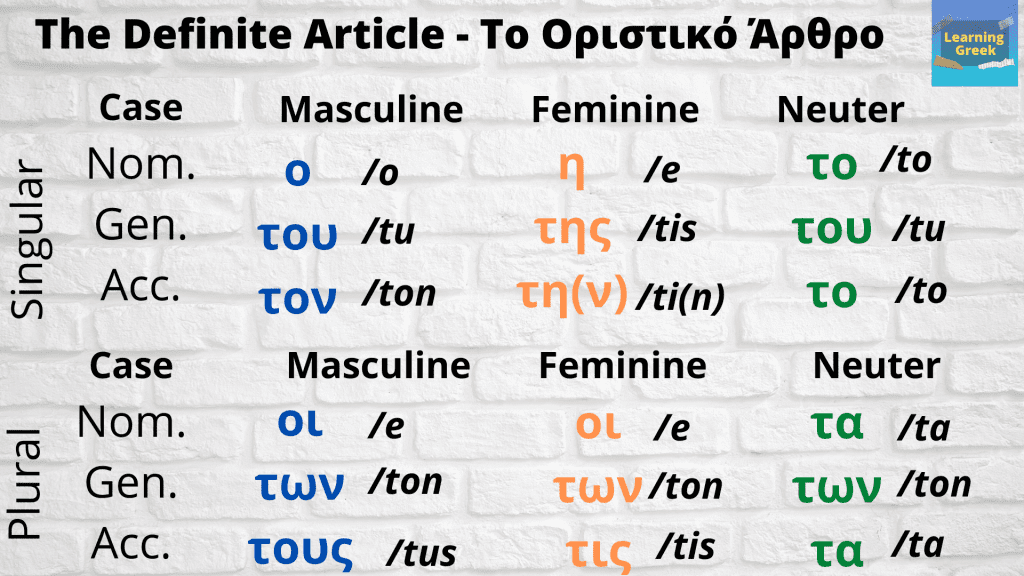
Definite forms of the Greek article
Think of the definite article as saying “this specific thing.”
Analytically, we use the definite article when:
1. we want to refer to a specific person, animal or object.
For example:
Προτιμώ το λεωφορείο όταν ταξιδεύω παρά το τρένο
Protimo to leoforio otan taxidevo para to treno
I prefer the bus when I travel rather than the train
2. we want to refer to all persons or things belonging to the same species.
For example:
Το λιοντάρι είναι ο βασιλιάς των ζώων
To liontari einai o vasilias ton zoon
The lion is the king of the animals
3. We use proper nouns (words that start with a capital letter).
For example:
η Αθήνα
e Athina
(the) Athens
Declension
When to skip the Greek article
The Greek definite article has no Vocative case.
When we call someone directly, we leave the noun without an article or we use ω or ε.
Examples:
1. Θεέ μου, βοήθησέ με! – Thee mou, voithise me – My God, help me!
2. Ω Θεέ μου, βοήθησέ με! – O Thee mou, voithise me – Oh my God, help me!
3. E, πού πας; – E, pou pas; – Hey, where are you going?
The feminine “ν” rule
The accusative case of the feminine article retains the final ν when the word starts with a vowel or from κ, π, τ, ξ, ψ, γκ, μπ, ντ, τσ, τζ.
Let’s see some examples:
1. η χώρα / τη χώρα – e hora / ti chora – country
2. η ώρα / την ώρα – e ora / tin ora – hour
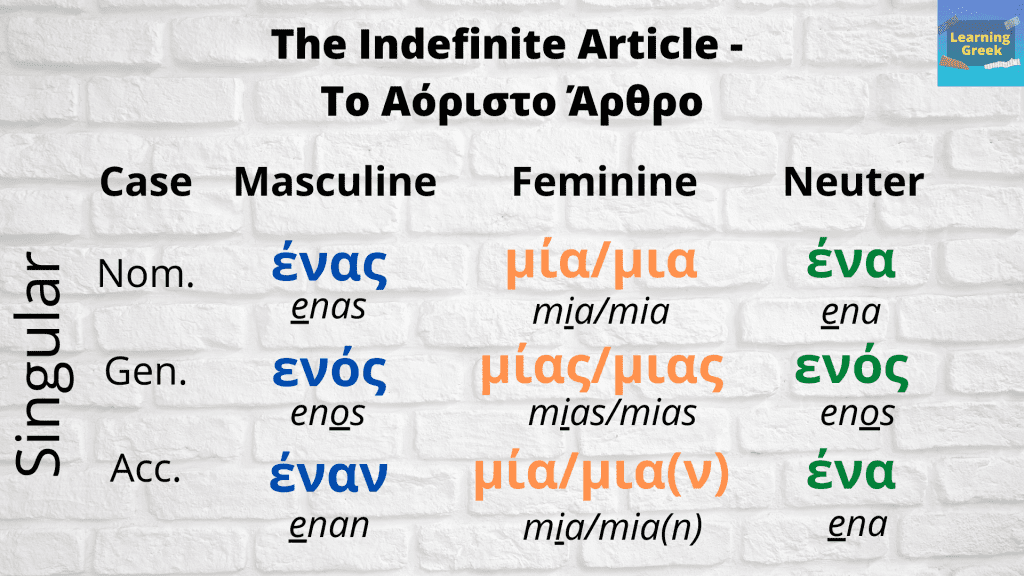
Indefinite forms of the Greek article
We use the Indefinite article when we refer to something indefinite and unknown or when we refer to something for the first time.
For example:
Ήταν ένα όμορφο απόγευμα
Itan ena omorfo apogevma
It was a beautiful evening
Declension
Notes:
The indefinite article has no plural form.
indefinite pronouns can be used instead. Like the definite article, it has no Vocative case.
The accusative case of the feminine article is mainly used without the final ν.
For euphony reasons, the final ν can be used when the next word starts with a vowel.
See the below example:
Θα τα πούμε μιαν άλλη φορά
Tha ta poume mian ali fora
We’ll talk another time
One last thing, I promise 🙂
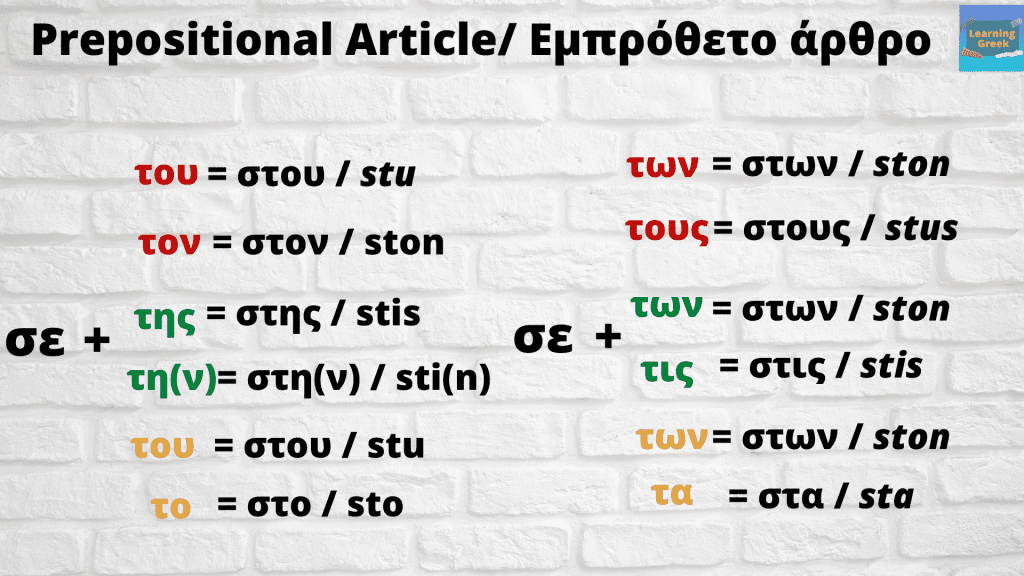
The Prepositional article
As you read Greek, there’s a chance that you may have stumbled upon little words such as στου, στης, στων etc.
These words are also articles which are the result of the combination of the preposition σε + the Genitive and Accusative case (singular and plural) of the Definite article.
So, we have the following types:
Let’s see some examples:
1. Θα έρθω στις 10:00 – Tha ertho stis 10:00 – I will come at 10:00
2. Θα πάμε στο σπίτι του Γιώργου – Tha pame sto spiti tou Yorgou – We will go to George’s house
3. Πηγαίνει στην αγορά – Piyenei stin agora – He is going to the market
One last tip before you go, go.
If a group includes at least one male, Greek uses the masculine plural.
More help with the Greek article
Feeling overwhelmed?
Don’t worry!
Greek articles take some practice, but soon it will all start to click.
To strengthen your skills, check this helpful guide on
avoiding common mistakes with Greek articles and try this
Greek Article Quiz to test what you’ve learned so far!
If you want to dive deeper, you can explore more lessons in the Beginners Category.
Take it step by step, and enjoy the journey 🙂

Pingback: What Does Μεράκι Mean? – One Greek Word at a Time - Learning Greek
Pingback: A Beginner’s Guide to Constructing Phrases in Greek - Learning Greek