
Hello my dearests! We’ve already seen how to count in Greek so you probably feel comfortable with the basics of Greek numbers by now. But numbers in Greek can do more than just help us count. Very often, they behave like adjectives and change depending on the noun they describe.
In this lesson, we’ll take a closer look at Greek numbers and see how cardinal and ordinal numbers are used in everyday Greek. It’s simpler than it looks, and once you understand the patterns, everything starts to make sense.
Cardinal Greek Numbers
Since cardinal numbers are considered adjectives in Greek, they need to agree in gender, number and case with the noun they define.
But don’t fret!
Not all numbers are inflected. Actually just a few of them change their form and the rest remain the same for all genders.
But let’s see some examples first of the numbers that change form and a table of contents will follow with all Greek cardinal numbers that are inflected, to have as a guide.
The number 1
We already have seen that 1 is ένα (ena) in Greek.
The word ένα is also used to indicate the neutral noun.
So, if we wanted to say for instance “one table”, we would say ένα τραπέζι (ena trapezi) because the word is neutral in Greek. Το τραπέζι.
But what happens if we want to use καναπές (kanapes) – sofa which is masculine or καρέκλα (karekla) – chair which is feminine?
Then we’re gonna use ένας and μία.
Let’s see this a little bit more analytically.
1 – ένας (enas), μία (mia), ένα (ena)
ο καναπές – ένας καναπές (enas kanapes) – one sofa
η καρέκλα – μία καρέκλα (mia karekla) – one chair
το τραπέζι – ένα τραπέζι (ena trapezi) – one table
Note:
For number 11 there’s no inflection, but all other numbers that end in 1 are inflected.
Let’s see how this works with number 11 and with all other numbers that they don’t chαnge form:
έντεκα καναπέδες (endeka kanapedes) – eleven sofas
έντεκα καρέκλες (endeka karekles) – eleven chairs
έντεκα τραπέζια (endeka trapezia) – eleven tables
The Greek Numbers 3 and 4
As we said before, not all numbers are inflected.
Numbers 3 and 4 are inflected as well, along with all the numbers that end with these digits. Those two numbers have the same form for masculine and feminine and change for neutral.
Let’s see some examples:
Number 3
τρεις καναπέδες (treis kanapedes)
τρεις καρέκλες (treis karekles)
τρία τραπέζια (tria trapezia)
είκοσι τρεις καναπέδες (eikosi treis kanapedes)
είκοσι τρεις καρέκλες (eikosi treis karekles)
είκοσι τρία τραπέζια (eikosi tria trapezia)
Number 4
τέσσερις καναπέδες (teseris kanapedes)
τέσσερις καρέκλες (teseris karekles)
τέσσερα τραπέζια (tesera trapezia)
εκατόν τέσσερις καναπέδες (ekaton teseris kanapedes)
εκατόν τέσσερις καρέκλες (ekaton teseris karekles)
εκατόν τέσσερα τραπέζια (ekaton tesera trapezia)
Table of Greek Cardinal Numbers that are inflected
Apart from 1, 3 and 4 and all the numbers that end with these digits, as we count in Greek, we will also come across a few other numbers that are inflected.
I have put all those numbers in a table below, to make your life easier.
For numbers 1, 3, and 4 I have used only some examples because they always are inflected when a number ends with them.
You can read more about numbers here.
The number 1000 χίλια (hilia) is used until the number 1999.
After that, we always use χιλιάδες (hiliades).
| Greek Numbers | Greek Cardinal Numbers that are inflected |
| 1 | ένας, μία-μια, ένα – enas, mia-mia, ena |
| 3 | τρεις, τρία – treis, tria |
| 4 | τέσσερις, τέσσερα – tesereis, tesera |
| 13 | δεκατρείς, δεκατρία – dekatreis, dekatria |
| 14 | δεκατέσσερις, δεκατέσσερα – dekateseris, dekatesera |
| 21 | είκοσι ένας, είκοσι μία, είκοσι ένα – eikosi enas/mia/ena |
| 23 | είκοσι τρεις, είκοσι τρία – eikosi treis/tria |
| 24 | είκοσι τέσσερις, είκοσι τέσσερα – eikosi teseris/tesera |
| 101 | εκατόν ένας, εκατόν μία, εκατόν ένα – ekaton enas/mia/ena |
| 200 | διακόσιοι, διακόσιες, διακόσια – diakosioi, diakosies, diakosia |
| 300 | τριακόσιοι, τριακόσιες, τριακόσια – triakosioi, triakosies, triakosia |
| 400 | τετρακόσιοι, τετρακόσιες, τετρακόσια – tetrakosioi, tetrakosies, tetrakosia |
| 500 | πεντακόσιοι, πεντακόσιες, πεντακόσια –pendakosioi/-ies/-ia |
| 600 | εξακόσιοι, εξακόσιες, εξακόσια – eksakosioi, eksakosies, eksakosia |
| 700 | εφτακόσιοι, εφτακόσιες, εφτακόσια – eftakosioi, eftakosies, eftakosia |
| 800 | οχτακόσιοι, οχτακόσιες, οχτακόσια – ohtakosioi, ohtakosies, ohtakosia |
| 900 | εννιακόσιοι, εννιακόσιες, εννιακόσια – eniakosioi, eniakosies, eniakosia |
| 1000 | χίλιοι, χίλιες, χίλια – hilioi, hilies, hilia |
| 2000 | δύο χιλιάδες – dio hiliades |
| 10000 | δέκα χιλιάδες – deka hiliades |
| 100000 | εκατό χιλιάδες – ekato hiliades |
Ordinal Greek Numbers
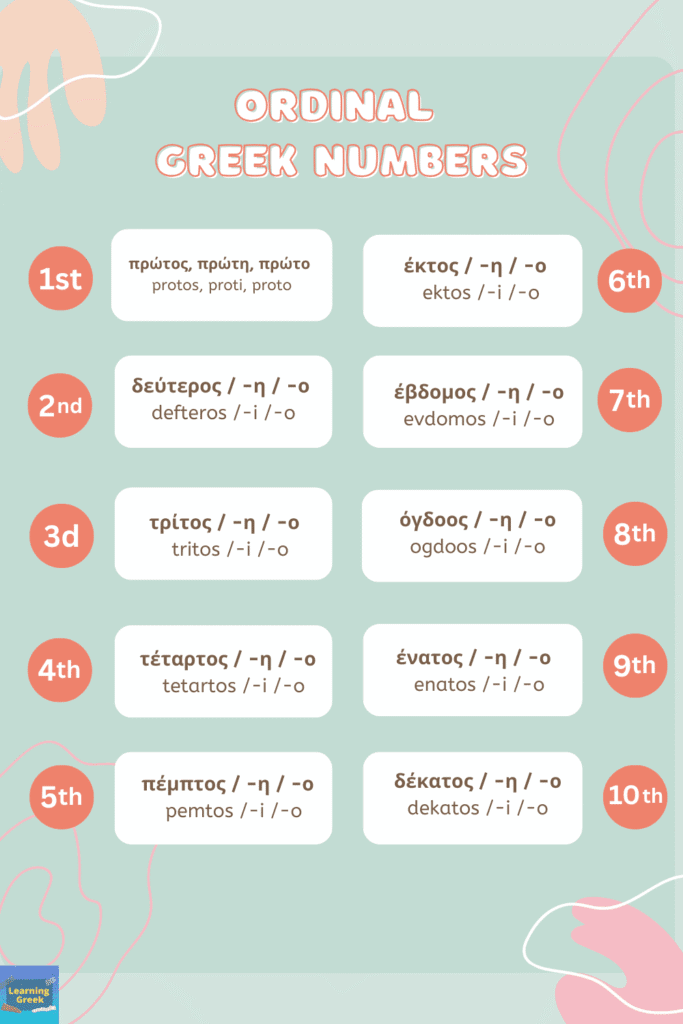
Ordinal numbers show the order of an individual or an item.
In Greek, they are also considered adjectives so they need to agree in gender, number and case with the noun they define.
So, for each one of them, we have three variations depending on the gender of the noun.
In the table below, you can see all Greek ordinals.
Table of Greek Ordinal Numbers
| Greek Ordinal Numbers | |
| 1st | πρώτος, πρώτη, πρώτο – protos, proti, proto |
| 2nd | δεύτερος / -η / -ο – defteros /-i /-o |
| 3d | τρίτος / -η / -ο – tritos /-i /-o |
| 4th | τέταρτος / -η / -ο – tetartos /-i /-o |
| 5th | πέμπτος / -η / -ο – pemtos /-i /-o |
| 6th | έκτος / -η / -ο – ektos /-i /-o |
| 7th | έβδομος / -η / -ο – evdomos /-i /-o |
| 8th | όγδοος / -η / -ο – ogdoos /-i /-o |
| 9th | ένατος / -η / -ο – enatos /-i /-o |
| 10th | δέκατος / -η / -ο – dekatos /-i /-o |
| 11th | ενδέκατος / -η / -ο – endekatos /-i /-o |
| 12th | δωδέκατος / -η / -ο – dodekatos /-i /-o |
| 13th | δέκατος / -η / -ο τρίτος / -η / -ο – dekatos /-i /-o tritos /-i /-o |
| 14th | δέκατος / -η / -ο τέταρτος / -η / -ο – dekatos /-i /-o tetartos /-i /-o |
| 15th | δέκατος / -η / -ο πέμπτος / -η / -ο – dekatos /-i /-o pemtos /-i /-o |
| 16th | δέκατος / -η / -ο έκτος / -η / -ο – dekatos /-i /-o ektos /-i /-o |
| 17th | δέκατος / -η / -ο έβδομος / -η / -ο – dekatos /-i /-o evdomos /-i /-o |
| 18th | δέκατος / -η / -ο όγδοος / -η / -ο – dekatos /-i /-o ogdoos /-i /-o |
| 19th | δέκατος / -η / -ο ένατος / -η / -ο – dekatos /-i /-o enatos /-i /-o |
| 20th | εικοστός / -ή / -ό – eikostos /-i /-o |
| 21st | εικοστός / -ή / -ό πρώτος / -η / -ο – eikostos /-i /-o protos /-i /-o |
| 22nd | εικοστός / -ή / -ό δεύτερος / -η / -ο – eikostos /-i /-o defteros /-i /-o |
| 30th | τριακοστός / -ή / -ό – triakostos /-i /-o |
| 40th | τεσσαρακοστός / -ή / -ό – tesarakostos /-i /-o |
| 50th | πεντηκοστός / -ή / -ό – pendikostos /-i /-o |
| 60th | εξηκοστός / -ή / -ό – eksikostos /-i /-o |
| 70th | εβδομηκοστός / -ή / -ό – evdomikostos /-i /-o |
| 80th | ογδοηκοστός / -ή / -ό – ogdoikostos /-i /-o |
| 90th | ενενηκοστός / -ή / -ό – enenikostos /-i /-o |
| 100th | εκατοστός / -ή / -ό – ekatostos /-i /-o |
| 101st | εκατοστός / -ή / -ό πρώτος / -η / -ο – ekatostos /-i /-o protos /-i /-o |
| 110th | εκατοστός / -ή / -ό δέκατος / -η / -ο – ekatostos /-i /-o dekatos /-i /-o |
| 200th | διακοσιοστός / -ή / -ό – diakosiostos /-i /-o |
| 300th | τριακοσιοστός / -ή / -ό – triakosiostos /-i /-o |
| 400th | τετρακοσιοστός / -ή / -ό – tetrakosiostos /-i /-o |
| 500th | πεντακοσιοστός / -ή / -ό – pendakosiostos /-i /-o |
| 600th | εξακοσιοστός / -ή / -ό – eksakosiostos /-i /-o |
| 700th | εφτακοσιοστός / -ή / -ό – eftakosiostos /-i /-o |
| 800th | οχτακοσιοστός / -ή / -ό – ohtakosiostos /-i /-o |
| 900th | εννιακοσιοστός / -ή / -ό – eniakosiostos /-i /-o |
| 1.000th | χιλιοστός / -ή / -ό – hiliostos /-i /-o |
| 2.000th | δισχιλιοστός / -ή / -ό – thishiliostos /-i /-o |
| 10.000th | δεκακισχιλιοστός / -ή / -ό – dekakishiliostos /-i /-o |
| 100.000th | εκατοντακισχιλιοστός / -ή / -ό – ekatontakishiliostos /-i /-o |
| 1.000.000th | εκατομμυριοστός / -ή / -ό – ekatomiriostos /-i /-o |
| 1.000.000.000th | δισεκατομμυριοστός / -ή / -ό – thisekatomisiostos /-i /-o |
Examples
Now let’s see some examples:
Ο Γιώργος ήταν ο πρώτος που τελείωσε την εργασία του
(Ο Υorgos itan o protos pou teleiose tin ergasia tou)
George was the first to finish his homework
Είμαι το τρίτο παιδί στην οικογένεια
(Eimai to trito paidi stin oikogeneia)
I’m the third child in the family
Σου είπα για εκατομμυριοστή φορά, ότι αυτό που κάνεις δε μου αρέσει
( Sou eipa gia ekatomiriosti fora oti afto pou kaneis de mou aresei)
I told you for the millionth time, that I don’t like what you are doing
Το όνομά μου είναι τριακοστό πέμπτο στον κατάλογο
(To onoma mou einai triakosto pempto ston katalogo)
My name is thirty-fifth on the list
Είναι τα εκατοστά δεύτερα γενέθλιά της
(Einai ta ekatosta deftera yenethlia tis)
It is her one hundred and second birthday
Wrapping Up Greek Numbers
And that’s a gentle introduction to Greek numbers beyond simple counting. Don’t worry if some forms feel unfamiliar at first with a little practice, they quickly become natural.
If you have questions or examples you’d like to share, feel free to leave a comment.
See you in the next lesson! 😊