
Hello, my awesome Greek learners! Today we’ll explore the seasons in Greek. Spring, summer, autumn, and winter. Knowing the seasons is essential because you’ll use them every day when talking about the weather, holidays, plans, and events.
If you haven’t learned Days of the Week in Greek or Months in Greek yet, check those out first. They create a solid foundation for talking about time in Greek!
In this guide, we’ll learn the four seasons in Greek, how to pronounce them, and some useful words and phrases you can use when talking about the weather and different times of the year.
But there’s more to the seasons than just vocabulary. Each one has its own traditions, celebrations, foods, and customs in Greece, so along the way, we’ll also explore a little of what each season looks and feels like in Greek life.
Ready to dive in?
The Seasons in Greek: Names and Pronunciation
Before we learn the seasons in Greek, it’s useful to know the Greek word for season:
Η εποχή (I epohí) – Season
Οι εποχές (I epohés) – Seasons
Now let’s learn the four seasons in Greek!
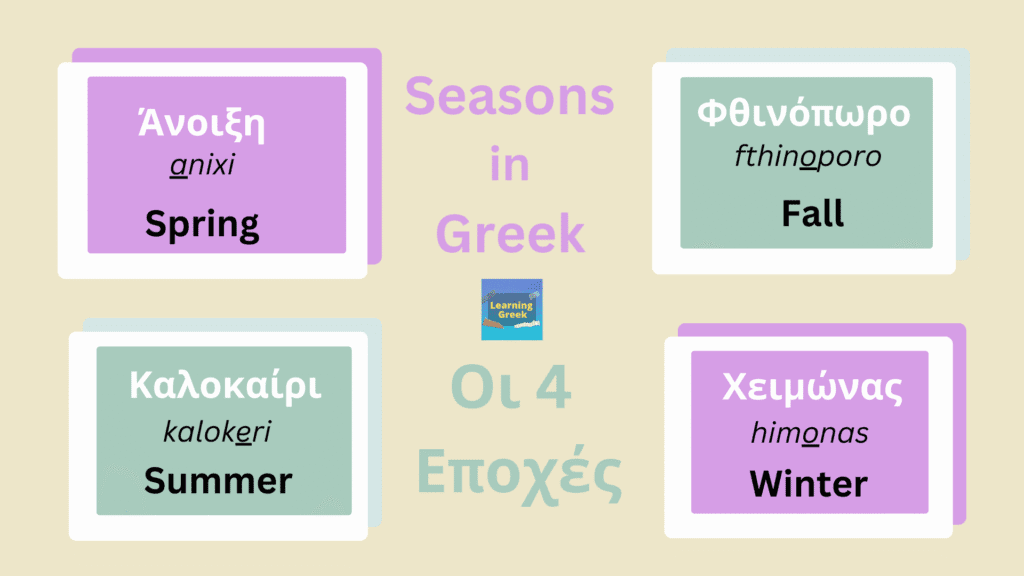
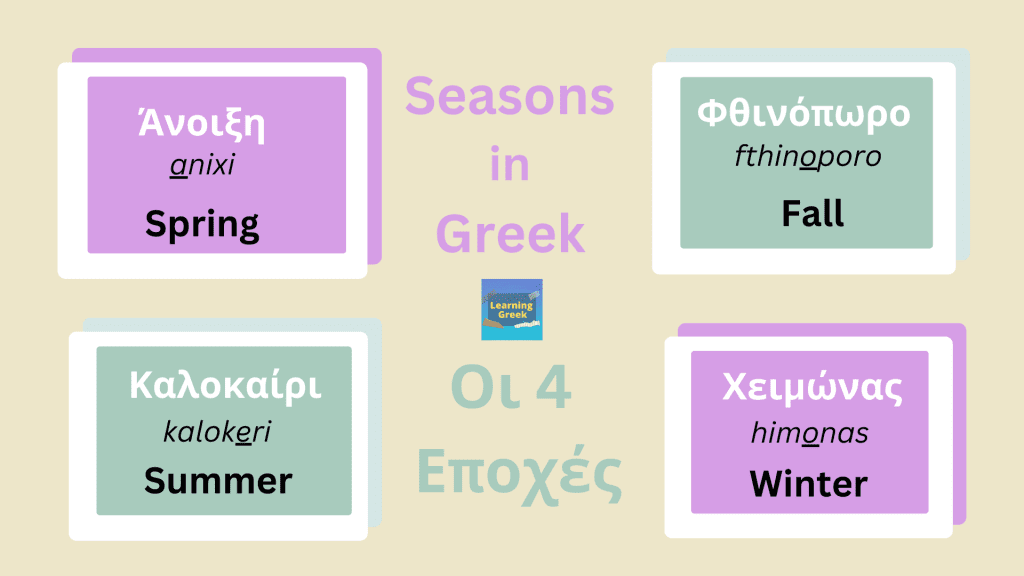
- (Η) Άνοιξη (Ánixi) – Spring – When the flowers bloom, and the gods host garden parties.
- (Το) Καλοκαίρι (Kalokéri) – Summer – Time for epic beach battles with Poseidon.
- (Το) Φθινόπωρο (Fthinóporo) – Autumn/Fall – The leaves fall, and so do the olives.
- (Ο) Χειμώνας (Himónas) – Winter – Even Zeus puts on a coat. It’s cold up on Mount Olympus!
Contrary to days and months, seasons do not need to start with a capital letter.
Example Sentences
Η άνοιξη είναι η αγαπημένη μου εποχή. (I ánixi íne i agapiméni mou epohí) – Spring is my favorite season.
Την άνοιξη ανθίζουν τα λουλούδια (Tin ánixi anthízun ta lulúdia) – In spring the flowers bloom
Το καλοκαίρι πηγαίνουμε στην παραλία. (To kalokéri pigénoume stin paralía) – In summer, we go to the beach.
Το καλοκαίρι στην Ελλάδα οι μέρες είναι πολύ ζεστές. (To kalokéri stin Ellada ee meres eene polee zestes) – In Greece, during summer, the days are very hot.
Το φθινόπωρο τα φύλλα πέφτουν. (To fthinóporo ta filla péftoun) – In autumn, the leaves fall.
Το φθινόπωρο ο καιρός αλλάζει και γίνεται πιο δροσερός. (To fthinóporo o keros allazee ke yinete pio droseros) – In autumn, the weather changes and becomes cooler.
Τον χειμώνα φοράμε ζεστά ρούχα. (Ton himóna foráme zestá rúha) – In winter, we wear warm clothes.
Τον χειμώνα, πηγαίνουμε για σκι. (Τon Himóna, piyénume ya ski) – In winter, we go skiing.
Additional Vocabulary Related to Seasons in Greek
Now that you know the four seasons and have seen how to use them in phrases, let’s look at some additional vocabulary related to the seasons.
ο καιρός (kerós) – weather
η ημέρα / η μέρα (iméra / méra) – day
ο μήνας (mínas) – month
η χρονιά / το έτος (hroniá / étos) – year
το ημερολόγιο (imerolóyio) – calendar
Learning the seasons in Greek is also a great way to build vocabulary you can use when talking about everyday life, weather, and plans.
Interesting Facts About the Seasons in Greece
You know the seasons, you’ve learned some useful vocabulary, and you’ve seen how to use them in phrases. But what are the seasons actually like in Greece? Let’s take a look at some interesting facts, traditions, and customs that make each one unique.
Traditional Festivals:
Each season in Greece is marked by traditional festivals (πανηγύρια – paniyiria) that celebrate local customs, religious events, or seasonal harvests. These festivals often include music, dancing, feasting, and community gatherings.
Religious Significance:
Seasons like spring and Easter (Πάσχα – Pasha) hold significant religious importance in Greece. Easter, in particular, is celebrated with various customs including midnight church services, the cracking of red-dyed eggs (κόκκινα αυγά – kokkina avga), and special Easter bread (τσουρέκι – tsureki).
Agricultural Practices:
Each season influences agricultural practices in Greece. For example, spring is the time for planting and the blossoming of flowers and fruit trees. Autumn is the season for harvesting olives and grapes, which are essential for producing olive oil and wine, respectively.
Seasonal Foods:
Greek cuisine is closely tied to seasonal ingredients. For instance, summer is the peak season for fresh vegetables like tomatoes, cucumbers, and peppers, which are used in dishes like Greek salad (χωριάτικη σαλάτα – horiatiki salata). Autumn brings a bounty of figs, chestnuts, and mushrooms used in various traditional recipes.
Tourism and Travel:
Summer is the peak tourist season in Greece, drawing visitors from around the world to its beautiful islands and coastal regions. This season is ideal for swimming, sunbathing, and enjoying outdoor activities.
Winter Traditions:
Winter in Greece brings traditions such as Christmas (Χριστούγεννα – Hristuyenna) and New Year (Πρωτοχρονιά – Protohronia) celebrations. Christmas is marked by festive decorations, traditional sweets like melomakarona and kourabiedes, and gatherings with family and friends.
Climate Diversity:
Due to Greece’s geographical diversity, the climate and seasonal variations can differ significantly between regions. Coastal areas experience milder winters and hot summers, while mountainous regions may have colder winters with snowfall.
Wrap-Up
And that’s a wrap on the seasons in Greek!
Now you know the names of spring, summer, autumn, and winter and how Greeks connect seasons with traditions and holidays.
Keep practicing by noticing the seasons around you and saying them aloud in Greek — it’s a simple way to make them stick in your memory.
Once you feel confident, you’re ready to continue your Greek journey and link what you’ve learned about days, months, and seasons to actual dates in everyday conversations.
Keep Learning Greek
Want to keep learning? You might also enjoy these related articles on the days of the week, the months, and how to say dates in Greek:
🗓️ Days of the Week in Greek – Learn weekdays, their meanings, and cultural facts.
🗓️ Months in Greek – Learn all 12 months, pronunciation, and useful phrases.
📅 Dates in Greek – Ask and write dates like a native Greek speaker.