
Γεια σας φιλαράκια!
If you’ve ever tried asking for or giving directions in Greek, you know it can feel a little intimidating at first. Getting around in Greece is a lot of fun… as long as you know the right words.
Whether you’re helping a friend find a café, looking for the nearest museum, or trying to understand what someone just told you on a busy street corner, the right phrases make all the difference.
In this guide, we’ll go step by step through the most useful expressions people actually use in real life. Nothing complicated. Just clear, practical language that helps you sound natural and confident.
Because directions aren’t just vocabulary. They’re confidence. The moment you can say “turn left at the corner” or understand “it’s next to the pharmacy,” something shifts. You stop translating in your head and start communicating.
So let’s make this simple and practical.
1. Key Words for Directions in Greek
Before we build full sentences, let’s start with the core words you’ll hear all the time. These are the building blocks of Directions in Greek. Once these feel familiar, everything else becomes much easier.
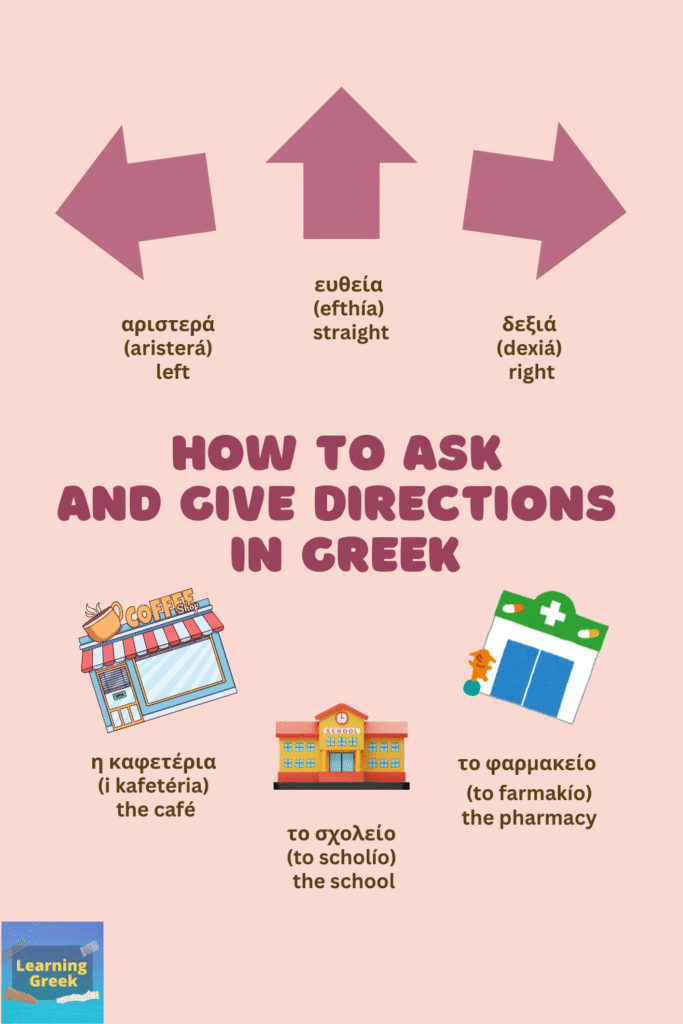
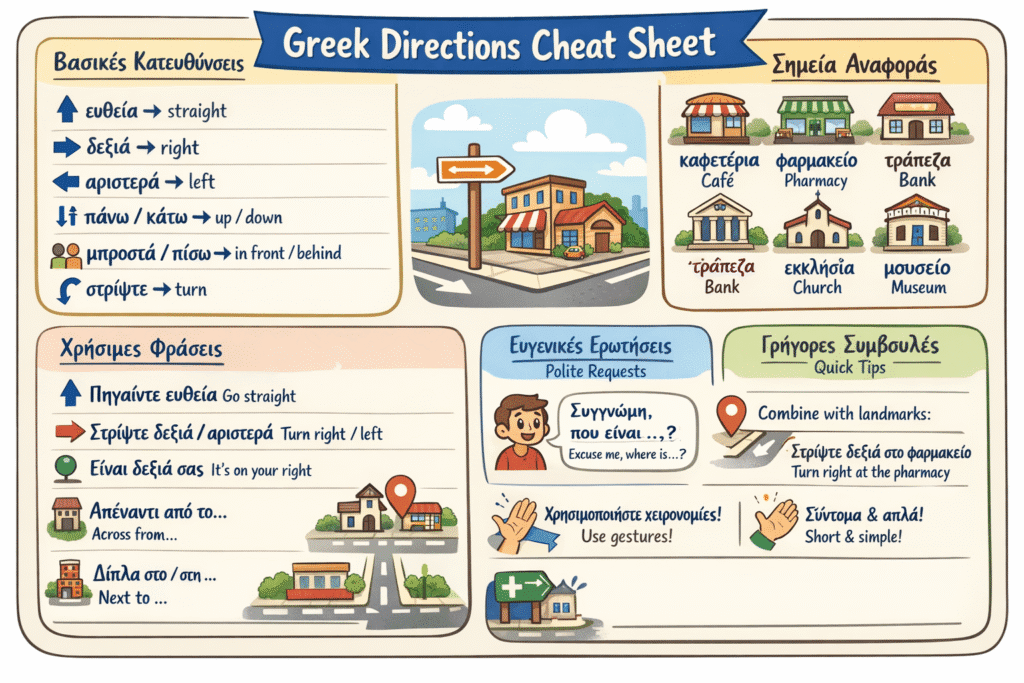
- ευθεία (efthía) – straight
- δεξιά (dexiá) – right
- αριστερά (aristerá) – left
- στη γωνία (sti gonía) – at the corner
- δίπλα (dípla) – next to / beside
- απέναντι (apénanti) – across
- πάνω / κάτω (páno / káto) – up / down
- μπροστά / πίσω (mprostá / píso) – in front / behind
2. Common Phrases for Giving Directions
Now let’s turn those words into real sentences. These are the phrases you’ll use most often when giving directions in Greek.
- πήγαινε ευθεία
(pígaine efthía)
go straight (singular) - πηγαίντε ευθεία
(pigaínte eftheía)
go straight (plural/polite) - στρίψε δεξιά / αριστερά
(strípse dexiá / aristerá)
turn right / left (singular) - στρίψτε δεξιά / αριστερά
(strípste dexiá / aristerá)
turn right / left (plural/polite) - είναι δεξιά / αριστερά σου
(eínai dexiá / aristerá sou)
it’s on your right / left (informal) - είναι δεξιά / αριστερά σας
(eínai dexiá / aristerá sas)
it’s on your right / left (polite) - δίπλα στο / στη …
(dípla sto / sti …)
next to the … - απέναντι από το / την …
(apénanti apó to / tin …)
across from the …
Mini examples
Example 1 (informal):
Πού είναι η καφετέρια;
(Poú eínai i kafetéria?)
Where is the café?
Πήγαινε ευθεία και στρίψε δεξιά στη γωνία.
(Píyene efthía kai strípse dexiá sti gonía.)
Go straight and turn right at the corner.
Example 2 (polite):
Πού είναι το μουσείο;
(Poú íne to mousío?)
Where is the museum?
Πηγαίντε ευθεία, μετά στρίψτε αριστερά.
(Pigente efthía, metá strípste aristerá.)
Go straight, then turn left.
3. Adding Landmarks
Greeks love using landmarks. Instead of giving exact distances, they’ll guide you using buildings, shops, or traffic lights.
- Το καφέ είναι δίπλα στην τράπεζα
(To kafé eínai dípla stin trápéza)
The café is next to the bank. - Το φαρμακείο είναι απέναντι από την εκκλησία
(To farmakío eínai apénanti apó tin ekklisía)
The pharmacy is across from the church. - Η στάση είναι δίπλα στο φανάρι
(I stási eínai dípla sto fanári) –
The bus stop is next to the traffic light. - Το μετρό είναι κάτω από την πλατεία
(To metró eínai káto apó tin platía)
The metro is under the square. - Το σχολεΙο είναι απέναντι από το ξενοδοχείο
(To scholío eínai apénanti apó to xenodochío)
The taxi is across from the hotel.
See? Very visual. Very practical.
4. Places & Landmarks
To understand directions, you need to recognize common places people mention. These come up constantly in everyday speech:
- η καφετέρια (i kafetéria) – the café
- το φαρμακείο (to farmakío) – the pharmacy
- η τράπεζα (i trápéza) – the bank
- η εκκλησία (i ekklisía) – the church
- η πλατεία (i platía) – the square
- το μουσείο (to mousío) – the museum
- το σχολείο (to scholío) – the school
- το νοσοκομείο (to nosokomío) – the hospital
- το ξενοδοχείο (to xenodochío) – the hotel
- ο φούρνος (o foúrnos) – the bakery
- ο σταθμός (o stathmós) – the station / stop
- το μετρό (to metró) – the metro
- η στάση (i stási) – the stop (bus/tram stop)
Mini example:
Πού είναι το σχολείο;
(Poú eínai to scholío?)
Where is the school?
Είναι δίπλα στην πλατεία και απέναντι από την τράπεζα.
(Eínai dípla stin platía kai apénanti apó tin trápéza.)
It’s next to the square and across from the bank.
5. Polite Ways to Ask for Directions in Greek
Now let’s switch roles. What if you’re the one asking? Here are some natural ways you’ll hear or use in Greece:
Συγγνώμη, μπορείτε να μου πείτε πώς να πάω στο / στη …;
(Signómi, boreíte na mou peíte pós na páo sto / sti …?)
Excuse me, can you tell me how to get to …? (polite)
Συγγνώμη, μπορείς να μου πεις πώς να πάω στο / στη …;
(Signómi, boreís na mou peis pós na páo sto / sti …?)
Excuse me, can you tell me how to get to …? (informal)
Μπορείτε να μου δείξετε πώς να πάω στο / στη …;
(Boreíte na mou deíxete pós na páo sto / sti …?)
Can you show me how to get to …? (polite)
Μπορείς να μου δείξεις πώς να πάω στο / στη …;
(Boreís na mou deíxeis pós na páo sto / sti …?)
Can you show me how to get to …? (informal)
Ξέρετε πώς να πάω στο / στη …;
(Xérete pós na páo sto / sti …?)
Do you know how to get to …? (polite)
Ξέρεις πώς να πάω στο / στη …;
(Xéreis pós na páo sto / sti …?)
Do you know how to get to …? (informal)
Είναι μακριά το / η …;
(Eínai makriá to / i …?)
Is … far? (casual, checking distance)
Πώς πάω στο / στη …;
(Pós páo sto / sti …?)
How do I get to …? (informal, short and common)
Πού είναι …;
(Poú eínai …?)
Where is …? (again informal)
6. Quick Tips to Sound Natural
A few small things that make you sound more Greek:
1. Combine directions with landmarks: στρίψτε δεξιά στο φαρμακείο (strípste dexiá sto farmakeío) – Turn right at the pharmacy
2, Use gestures while speaking—they’re very common in Greece
3. Keep instructions short and clear
4, Sprinkle casual words like μπροστά (mprostá) or πίσω (píso) to sound more conversational
7. Extra Useful Words & Expressions
Here are a few additional phrases you’ll often hear.
- στα φανάρια (sta fanária) – at the traffic lights
- η επόμενη γωνία (i epómeni gonía) – the next corner
- ο δρόμος (o drómos) – the street / road
- η διασταύρωση (i diastafrósi) – the intersection
- το πεζοδρόμιο (to pezodrómio) – the sidewalk
- ο πεζός (o pezós) – the pedestrian
- το λεωφορείο (to leoforeío) – the bus
- το ταξί (to taxí) – the taxi
- μέχρι το τέλος του δρόμου (méchri to télos tou drómou) – until the end of the street
- στην αρχή του δρόμου (stin archí tou drómou) – at the beginning of the street
- λίγο πιο κάτω (lígo pio káto) – a little further down
- λίγο πιο πάνω (lígo pio páno) – a little further up
- όλο ευθεία (olo efthía) – straight ahead / directly
Wrapping Up
And that’s it!
With these words and phrases, you can confidently give or follow directions anywhere in Greece. Remember, a quick gesture and a landmark go a long way—Greeks love using them. Next time someone asks for help, try guiding them naturally, and watch how smoothly it goes.
Want to discover even more common Greek phrases?
Don’t miss my article 100 Basic Greek Phrases for practical words you’ll actually use!