Hello my beautiful Greek learner enthusiasts!
Today we’re going to talk about some little, sneaky but very helpful Greek words that you come across all the time in Greek sentences, Yes, I’m talking about Greek conjuctions!
Greek conjuctions are words like και, ή, αλλά, γιατί. We’re going to analyze the most important of them, the ones you will actually see or need to use often, understand why they matter, compare them with English equivalents, and provide a list of all of them for reference.
But first, let’s see why they are so important.
Why Greek Conjuctions Are Actually Important?
Greek conjuctions might be tiny but they do a lot of heavy lifting.You may know hundreds of Greek verbs and nouns, but without these little connectors, you will not be able to construct real Greek sentences, and your Greek will sound robotic.
Consider these words like the glue of Greek sentences. They link ideas,stretch thoughts, soften meanings, and show how Greeks really communicate. Because unlike English, which prefers short sentences, Greeks like to connect ideas. That’s why Greek sentences often feel longer than English ones. It’s not that Greek is more complicated. It’s just that we are more social and chatty, and we like to connect thoughts in a row.
This is exactly why Greek conjuctions are very helpful!
And if you ever struggle to follow spoken Greek, bets are that a conjuction got missed.
Yes, they are that important!
Are Greek Conjuctions Just Like English Ones?
Short answer: yes!
Greek conjuctions work just like English ones. They link words, phrases, or clauses and don’t change form.
But here’s the tiny twist:
Greek speakers sometimes repeat conjuctions for rhythm or emphasis, and style or placement can shift depending on flow.Some words, like γιατί, do double duty as both “why” and “because”, which English keeps separate.
Examples to illustrate Natural Usage
1. Repetition/Rhythm
Έφαγα και ψωμί και τυρί και ελιές.
Éfaga ke psomí ke tyrí ke elíes.
Literal English: I ate and bread and cheese and olives.
Native English: I ate bread, cheese, and olives.
Repeating και for rhythm and emphasis is natural in Greek. English prefers just one “and”.
2. Combined functions
Γιατί έφυγες; Έφυγα γιατί κουράστηκα.
Yiatí éfiyes? / Éfiga yiatí kurástika.
English: Why did you leave? I left because I was tired.
Greek uses γιατί for both question and answer, unlike English.
3. Stylistic alternatives
Δεν ήρθα επειδή δούλευα.
Den írtha epidhí doúleva.
English: I didn’t come because I was working.
Επειδή can replace γιατί for nuance or formality. English has only “because”.
As you can see, Greek conjuctions work the same as English ones. The tiny differences are in natural usage, style, rhythm, and emphasis. Not in function. Knowing this makes your Greek sound smooth and native-like.
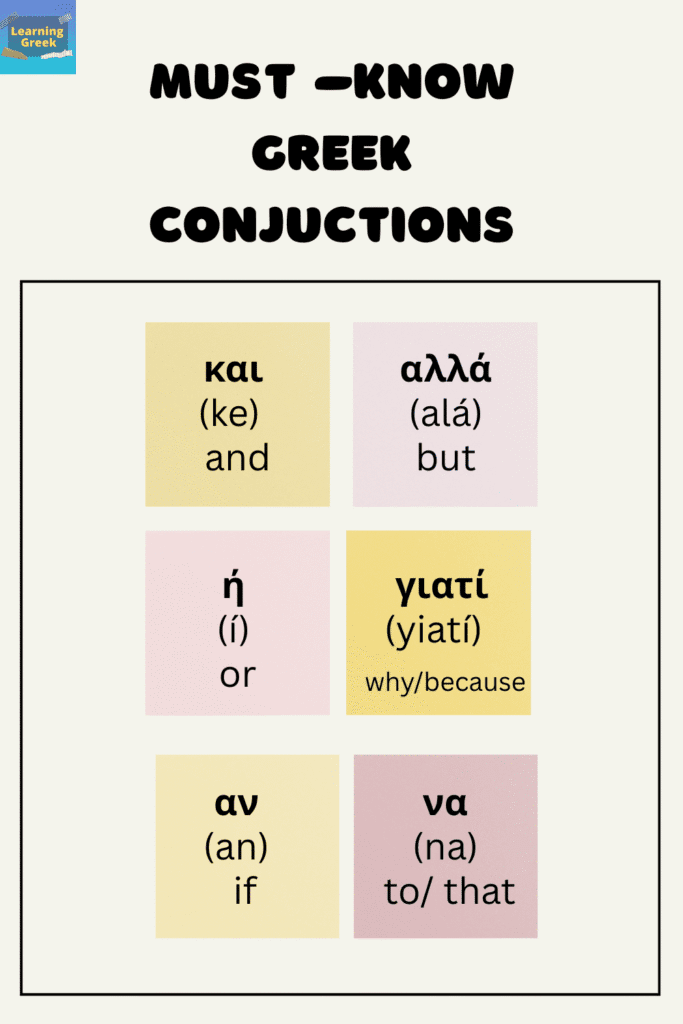
Must – Know Greek Conjuctions
These are absolute essentials. You’ll hear them constantly and you’ll need them early if you want your Greek to feel…Greek.
και (ke) – and
This is the most basic and most used Greek conjuction, It simply adds information. You use it to connect words, phrases, or actions. You will also meet this form: κι (ki) which is usually used before words that start with a vowel.
Example:
Πήγα δουλειά και γύρισα αργά.
Píga dulia ke yirisa argá.
I went to work and came back late.
αλλά (alá) – but
We use αλλά, to show contrast. It signals that what comes next goes against what you expect from the first part.
Example:
Θέλω να έρθω, αλλά δεν μπορώ σήμερα.
Thélo na értho, alá den boró símera.
I want to come, but I can’t today.
ή (í) – or
We use this Greek conjuction to express dilemmas, decisions. or choices.
Be carefule not to confuse it with the Greek article η. The conjuction always takes an accent mark, unlike the article, which is never stressed.
Example:
Θέλεις να έρθεις ή όχι;
Thélis na érthis í óchi?
Do you want to come or not?
γιατί (yiatí) – why/because
Well, as we already said. One word, two jobs
Example:
Γιατί άργησες; / Γιατί κοιμήθηκα.
Yiatí áryises? / Yiatí kimíthika.
Why were you late? / Because I overslept.
αν (an) – if
With αν. we show hypothesis.
Example:
Αν θέλεις, μιλάμε αύριο.
An thélis, miláme ávrio.
If you want, we’ll talk tomorrow.
να (na) – to/ that/subjunctive marker
Technically not just a conjuction but it’s a must – know.
Example:
Θέλω να φύγω.
Thélo na figo.
I want to leave.
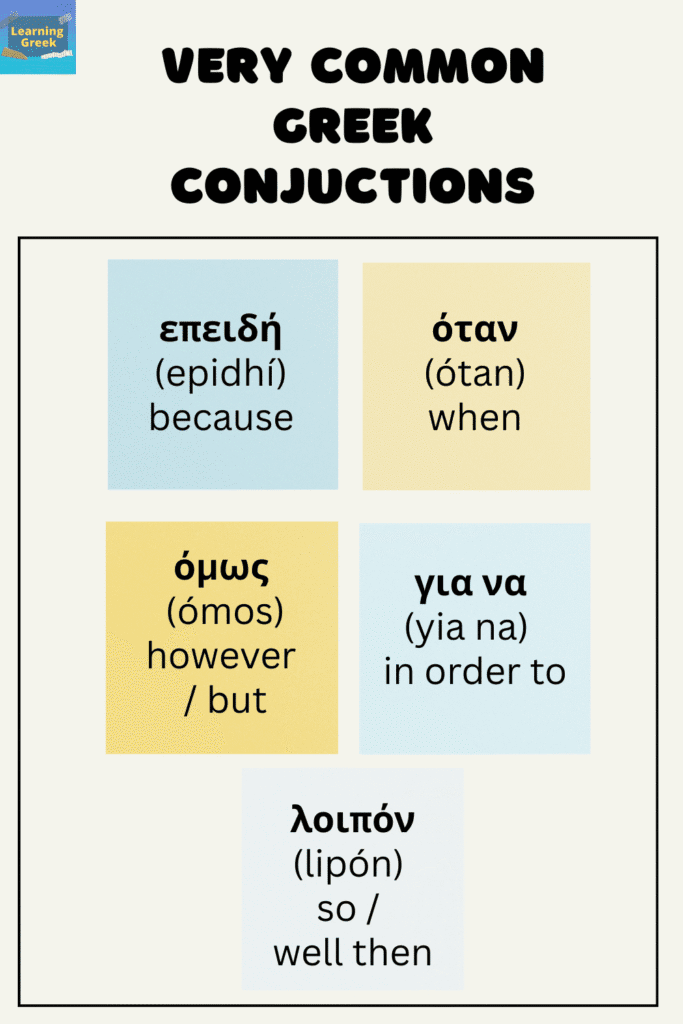
Very Common Greek Conjuctions, Slightly Tricky
You’ll hear these a lot. You don’t need to master them immediately, but it is good to recognize them.
επειδή (epidhí) – because
It is slightly more formal than γιατί. And we can also use it as an answer when we ask with γιατί.
Example:
Γιατί δεν ήρθες; / Δεν ήρθα επειδή δούλευα.
Yiatí den írthes? / Den írtha epidhí doúleva.
Why didn’t you come? / I didn’t come because I was working.
όμως (ómos) – however / but
Think of it as a softer contrast than αλλά.It can feel often more thoughtful.
Example:
Ήθελα να βοηθήσω, όμως δεν μπορούσα.
Íthela na voithíso, ómos, den borúsa.
I wanted to help but I couldn’t.
λοιπόν (lipón) – so / well then
Moves the conversation forward. It is widely used and its usual place is at the beginning of a phrase.
Example:
Λοιπόν, τι κάνουμε τώρα;
Lipón, ti kánume tóra?
So, what are we doing now?
όταν (ótan) – when
We use it as a time connector. You will see it a lot!
Example:
Όταν τελειώσω, σε παίρνω.
Ótan telióso, se pérno.
When I finish, I’ll call you.
για να (yia na) – in order to
Για να shows purpose and intention.
Example:
Δουλεύω για να βγάλω λεφτά.
Doulévo yιa na vgalo lefta.
I work in order to make money.
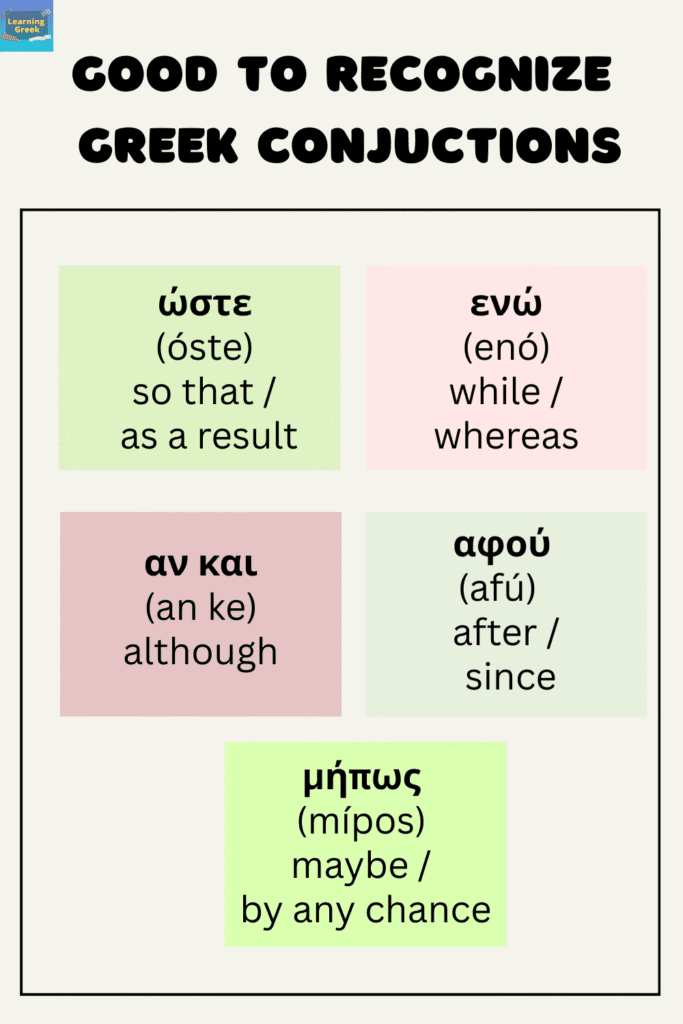
Good to Recognize, Not Urgent to Use
These are very useful Greek conjuctions. You’ll meet them in reading, news, formal speech, or more advanced conversations. If all these feel too much, don’t stress about them. For now, recognition is the goal.
ώστε (óste) – so that / as a result
This connects an action to its intended result or outcome. Sometimes it means για να, sometimes not.
Example:
Έκλεισε το παράθυρο ώστε να μην κάνει κρύο.
Éklise to paráthiro, óste na min káni krío.
He closed the window so that it wouldn’t be cold.
ενώ (enó) – while / whereas
This contrasts two actions or situations happening at the same time.
Example:
Εκείνος μιλούσε, ενώ εγώ άκουγα.
Ekínos milúse, enó egó ákuga.
He was talking, while I was listening.
αν και (an ke) – although
Another Greek conjuction that expresses contrast.
Example:
Αν και βιαζόταν, σταμάτησε.
An ke viazótan, stamátise.
Although she was in a hurry, she stopped.
αφού (afú) – after / since
Αφού is extremely flexible. It can mean time (after) or reason (since)
Example:
Αφού δεν πεινάς, πάμε βόλτα.
Afú den pinás, páme vólτa.
Since you’re not hungry, let’s go for a walk.
μήπως (mípos) -maybe / by any chance
Used for polite questions, worries, or uncertainty.
Example:
Μήπως κάναμε λάθος;
Mípos káname láthos?
Did we maybe make a mistake?
Final Thought
So, now you know.
Short, stiff sentences? Add conjuctions. They are the secret sauce to make your sentences feel
lively, natural, and more …Greekish.
Pay attention to these sneaky little words. They are small but have a big job. Greek has many more conjunctions, but these are the ones you’ll encounter and need first.