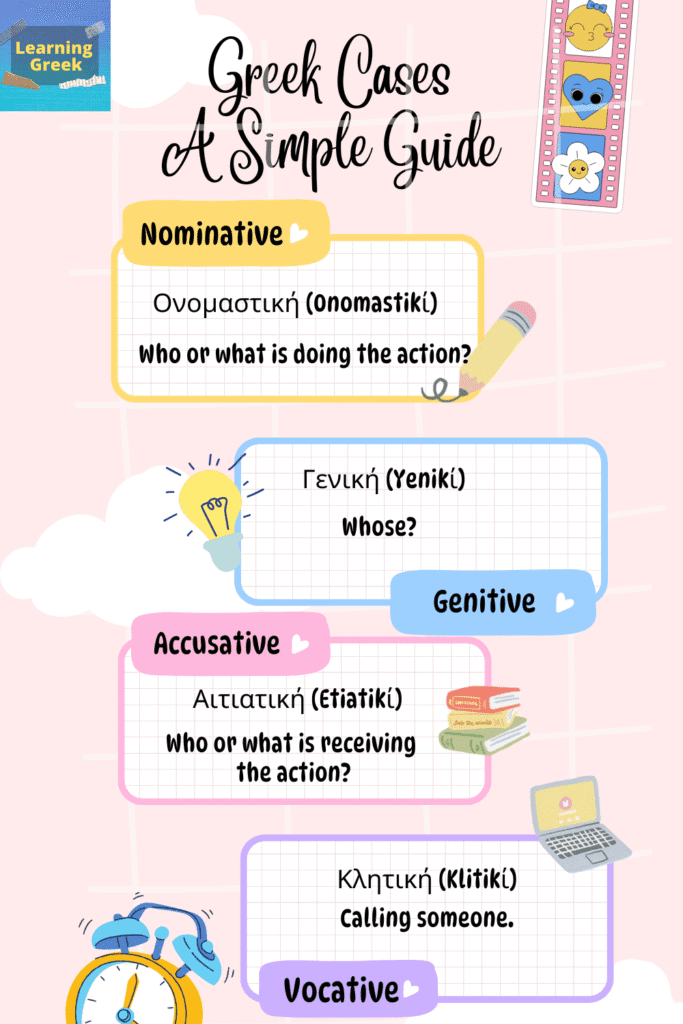

Hello, my enthusiastic Greek learner!
Today, we’re going to talk about Greek cases. You might be wondering: What are cases? Don’t worry! I’ll explain in a simple way.
In Greek, cases are used to change the form of nouns, adjectives, and pronouns depending on their role in the sentence. These changes help us understand the relationships between words. For example, a word might change when we are talking about who owns something, or who something is done to.
Some languages use cases to show how words work in a sentence. Cases help us understand who is doing what, who owns something, and more.
Let’s look at how cases affect nouns, adjectives, and pronouns.
Do Only Nouns and Adjectives Have Cases?
Yes! Cases apply to nouns, adjectives, and pronouns. Verbs don’t have cases because they use a different system called conjugation instead.
Greek Cases – Πτώσεις (Ptόsis)
Greek has four cases:
- Ονομαστική (Onomastikί) – Nominative
- Γενική (Yenikί) – Genitive
- Αιτιατική (Etiatikί) – Accusative
- Κλητική (Klitikί) – Vocative
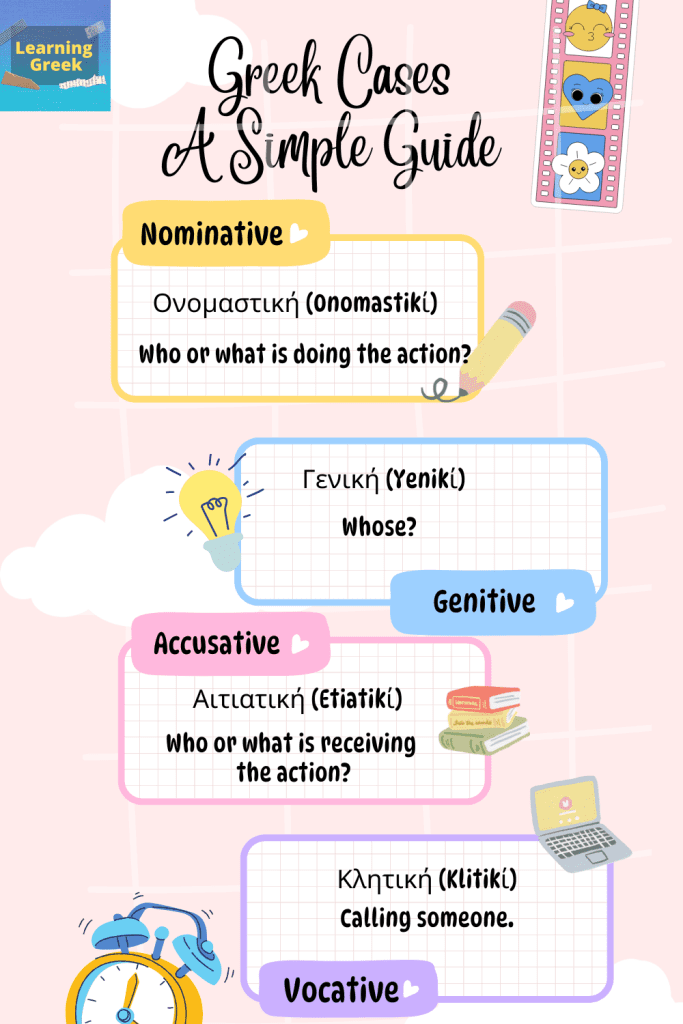
Let’s break them down one by one!
1. Ονομαστική (Nominative): The Naming Case
The ονομαστική (onomastikί) case is like the leader of the sentence. It tells us who or what is doing something. This is also the base form of a noun, the one you see in dictionaries.
Example 1: A simple sentence
Imagine your dog, Max, is running. If you say:
Ο Μαξ τρέχει.
(O Max tréhi.)
Max is running.
In this sentence, Ο Μαξ (O Max) is in the nominative case because Max is the one doing the action.
Example 2: Adding an adjective
Ο ψηλός άντρας τρέχει.
(O psilós ándras tréhi)
The tall man is running.
Ο άντρας (the man) is in the nominative case because he’s the subject.
The adjective ψηλός (tall) agrees with the noun in case, gender, and number
2. Γενική (Genitive): The “Belonging” Case
The γενική (yenikί) case is all about showing who owns something. It answers the question, “Whose?”
Example 1: A simple sentence
Think about your toy car. If it belongs to Max, you say:
Το αυτοκίνητο του Μαξ.
(To aftokínito tu Max)
Max’s car.
Here, του Μαξ (tu Max) is in the genitive case because it shows possession.
Example 2: Adding an adjective
Το βιβλίο του ψηλού άντρα.
(To vivlío tu psilú ándra)
The book of the tall man.
Του άντρα (of the man) is in the genitive case.
The adjective ψηλού (tall) matches the noun in case, gender, and number.
3. Αιτιατική (Accusative): The Action Receiver
The αιτιατική (etiatikί) case tells us what or who is is receiving the action.
Example 1: A simple sentence
If Max is chasing a ball, you say:
Ο Μαξ κυνηγάει την μπάλα.
(O Max kiniyái tin bála)
Max is chasing the ball.
Here, την μπάλα (tin bála) is in the accusative case because it’s the object being chased.
Example 2: Adding an adjective
Βλέπω τον ψηλό άντρα.
(Vlépo ton psiló ándra)
I see the tall man.
Τον άντρα (the man) is in the accusative case as it’s the receiver of the action.
The adjective ψηλό (tall) agrees with the noun in case, gender, and number.
4. Κλητική (Vocative): The Calling Case
The κλητική (klitikί) case is used to address someone directly.
Example 1: Calling a name
If you want Max to come to you, you say:
Μαξ, έλα εδώ!
(Max, éla edó!)
Max, come here!
Here, Μαξ (Max) is in the vocative case because he’s being called.
Example 2: Adding an adjective
Ψηλέ άντρα, έλα εδώ!
(Psilé ándra, éla edhó!)
Tall man, come here!
The adjective ψηλέ agrees with the noun άντρα in the vocative form.
Greek Cases in Short
1.Ονομαστική: Who or what is doing the action?
Example: Ο παππούς κοιμάται (O pappús kimáte) – Grandpa is sleeping.
2. Γενική: Whose?
Example: Η τσάντα της Μαρίας (I tsánda tis Marías) – Maria’s bag.
3. Αιτιατική: Who or what is receiving the action?
Example: Αγαπώ τη Μαρία (Aghapó ti María) – I love Maria.
4. Κλητική: Calling someone.
Example: Πάμε, παππού! (Páme, pappú!) – Let’s go, grandpa!
Greek Case Endings (Καταλήξεις)
Now that you’ve digested the purpose of each case, let’s look at the general rules for endings.
The endings below cover the most common patterns in Greek. While they apply to many nouns, pronouns, and adjectives, some words have irregular forms or follow less common patterns. As you continue learning, you’ll encounter these exceptions and learn them with practice.
Masculine Nouns and Adjectives
| Πτώση/Case | Ενικός/Singular | Πληθυντικός/Plural |
|---|---|---|
| Ονομαστική (Nominative) | -ος, -ης, -ας, | -οι, -ες |
| Γενική (Genitive) | -ου, -η, -α | -ων |
| Αιτιατική (Accusative) | -ο, -η, -α | -ους, -ες |
| Κλητική (Vocative) | -ε, -η, -α | -οι, -ες |
Feminine Nouns and Adjectives
| Πτώση/Case | Ενικός/Singular | Πληθυντικός/Plural |
|---|---|---|
| Ονομαστική (Nominative) | -α, -η | -ες |
| Γενική (Genitive) | -ας, -ης | -ων |
| Αιτιατική (Accusative) | -α, -η | -ες |
| Κλητική (Vocative) | -α, -η | -ες |
Neuter Nouns and Adjectives
| Πτώση/Case | Ενικός/Singular | Πληθυντικός/Plural |
|---|---|---|
| Ονομαστική (Nominative) | -ο, -ι, -ος, -μα | -α, -ια, -η |
| Γενική (Genitive) | -ου, -ιου, -ους, -ατος | -ων |
| Αιτιατική (Accusative) | -ο, -ι, -ος, -μα | -α, -ια, -η |
| Κλητική (Vocative) | -ο, -ι, -ος, -μα | -α, -ια, η |
Recap
- Only nouns, adjectives, and pronouns have cases, not verbs.
- In Greek, there are four cases: ονομαστική (nominative), γενική (genitive), αιτιατική (accusative), and κλητική (vocative).
- Each case changes the form of nouns, adjectives, and pronouns to show their role in the sentence.
Why Are Cases Cool? 😎
Cases may seem tricky, but they’re like secret codes! They tell us everything about the job of a word in a sentence. Practice makes perfect, and soon, you’ll be a language pro!