
Hello, Greek language explorers!
Are you ready to take your Greek to the next level?
Today, we’re focusing on Greek nouns—those building blocks of conversation that help you name, describe, and connect with the world around you. While basic nouns are perfect for everyday use, knowing their more advanced counterparts can make your speech sound polished, precise, and oh-so-sophisticated!
Why bother with advanced nouns?
Because they unlock nuance, add flair, and show off your growing mastery of the Greek language. Whether you’re preparing for formal writing, aiming to impress in conversation, or diving into Greek literature, these advanced nouns will help you stand out.
Let’s explore some basic nouns alongside their elevated alternatives—your new secret weapon for cultured communication!
Everyday Greek Nouns: Basic vs Advanced
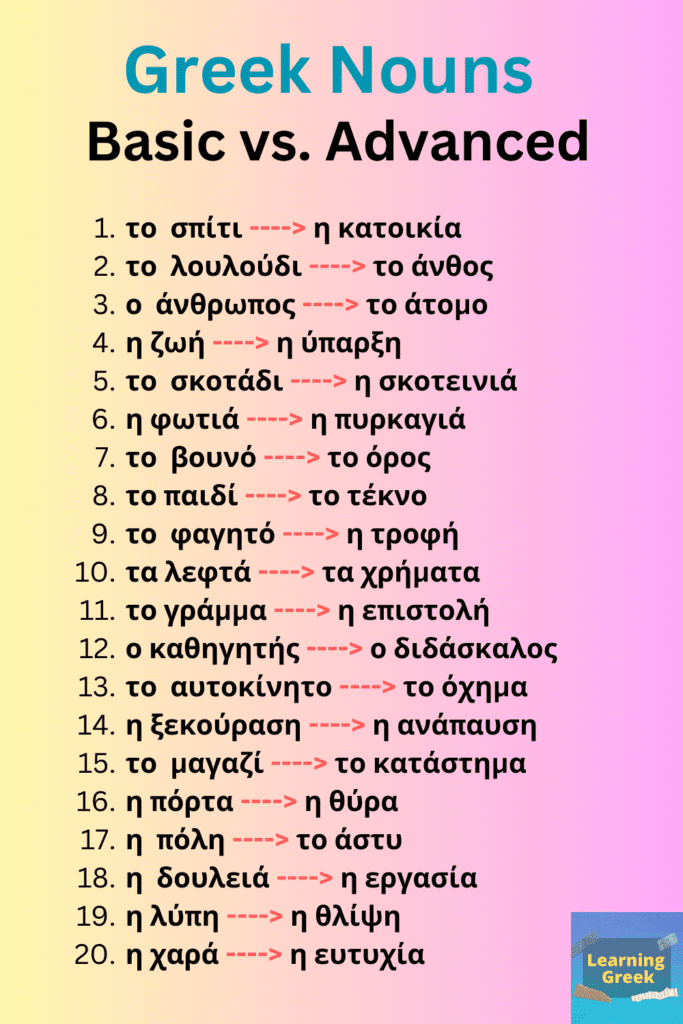
Below is a comparison table with 20 examples of basic Greek nouns alongside their advanced counterparts.
| Basic Noun | Advanced Noun | Meaning (English) |
|---|---|---|
| το σπίτι (to spíti) | η κατοικία ( i katoikía) | house / residence |
| το λουλούδι (to lulúdi) | το άνθος (to ánthos) | flower / blossom |
| ο άνθρωπος (ο ánthropos) | το άτομο (to átomo) | person / individual |
| η ζωή (i zoí) | η ύπαρξη (i íparxi) | life / existence |
| το σκοτάδι (to skotádi) | η σκοτεινιά (i skotiniá) | darkness / gloom |
| η φωτιά (i fotiá) | η πυρκαγιά (i pirkayiá) | fire / blaze |
| το βουνό (to vunó) | το όρος (to óros) | mountain / peak |
| το παιδί (to pedí) | το τέκνο (to tékno) | child / offspring |
| το φαγητό (to fayitó) | η τροφή (i trofi) | food / nourishment |
| τα λεφτά (ta leftá) | τα χρήματα (ta chrímata) | money / funds |
| το γράμμα (to gráma) | η επιστολή (i epistolí) | letter / correspondence |
| ο καθηγητής (o kathiyitís) | ο διδάσκαλος (o didáskalos) | teacher / educator |
| το αυτοκίνητο (to aftokínito) | το όχημα (to óchima) | car / vehicle |
| η ξεκούραση (i xekúrasi) | η ανάπαυση (i anápafsi) | rest / relaxation |
| το μαγαζί (to magazí) | το κατάστημα (to katástima) | shop |
| η πόρτα (i pórta) | η θύρα (i thira) | door |
| η πόλη (i póli) | το άστυ (to ásti) | city |
| η δουλειά (i duliá) | η εργασία (i ergasía) | work |
| η λύπη (i lípi) | η θλίψη (i thlípsi) | sadness / sorrow |
| η χαρά (i chará) | η ευτυχία (i eftichía) | joy / happiness |

Why Learn Advanced Nouns?
Advanced nouns help you:
- Express more precisely: Swap “house” (σπίτι) for “residence” (κατοικία) to elevate your tone.
- Sound professional: Advanced terms like “educational institution” (εκπαιδευτήριο) instead of “school” (σχολείο) are perfect for formal contexts.
- Add nuance: Using advanced alternatives signals your understanding of subtle meanings, making you a more engaging speaker.
A Tip for Success
Remember, practice is key! Start by introducing one or two advanced nouns into your conversations each week. Before you know it, you’ll be effortlessly switching between basic and more sophisticated vocabulary, impressing both native speakers and fellow learners.
And why stop at nouns? To further elevate your fluency, check out our Advanced Greek Verbs and Advanced Greek Adjectives. Expanding your vocabulary in these areas will allow you to express yourself with even greater precision and style. Keep pushing your boundaries and continue your journey to mastery!
Happy learning!