Hello my beautiful Greek learners!
We’ve already talked about Greek Personal and Possessive Pronouns so let’s keep building on that! Today we’re looking at the Greek demonstrative pronouns. The little words we use when we want to point at someone or something.
You already know αυτός (masc), αυτή (fem) and αυτό (neut). We use them when someone or something is close to us, the same way English uses this or these.
Now let’s look at their cousins: εκείνος (masc), εκείνη (fem) and εκείνο (neut). These point to things or people that are farther away, just like that or those in English.
But let’s break them down and see how they work.
Greek Demonstrative Pronouns
1. Εκείνος (Masculine Singular)
“Εκείνος” is the masculine singular form of the demonstrative pronoun and is used to refer to a male person or a masculine noun that is further away from the speaker. In English, it can be translated as “that one” or “that man.”
Examples:
- Εκείνος ο άντρας είναι ο δάσκαλός μου.
(Ekeenos o antras eene o daskalos mu)
That man is my teacher. - Μου αρέσει εκείνος ο σκύλος.
(Mu aresee ekeenos o skilos)
I like that dog.
2. Εκείνη (Feminine Singular)
“Εκείνη” is the feminine singular form of the demonstrative pronoun and is used to refer to a female person or a feminine noun that is further away from the speaker. In English, it can be translated as “that one” or “that woman.”
Examples:
- Εκείνη η γυναίκα είναι η μητέρα μου.
(Ekeeni i yineka eene i mitera mu)
That woman is my mother. - Εκείνη η καρέκλα είναι άνετη.
(Ekeeni i karekla eene aneti)
That chair is comfortable.
3. Εκείνο (Neuter Singular)
“Εκείνο” is the neuter singular form of the demonstrative pronoun and is used to refer to a neutral-gender noun or an inanimate object that is further away from the speaker. In English, it can be translated as “that one” or “that thing.”
Examples:
- Θέλω εκείνο το βιβλίο.
(Thelo ekeeno to vivlio)
I want that book. - Εκείνο το σπίτι είναι μεγάλο.
(Ekeeno to spiti eene megalo)
That house is big.
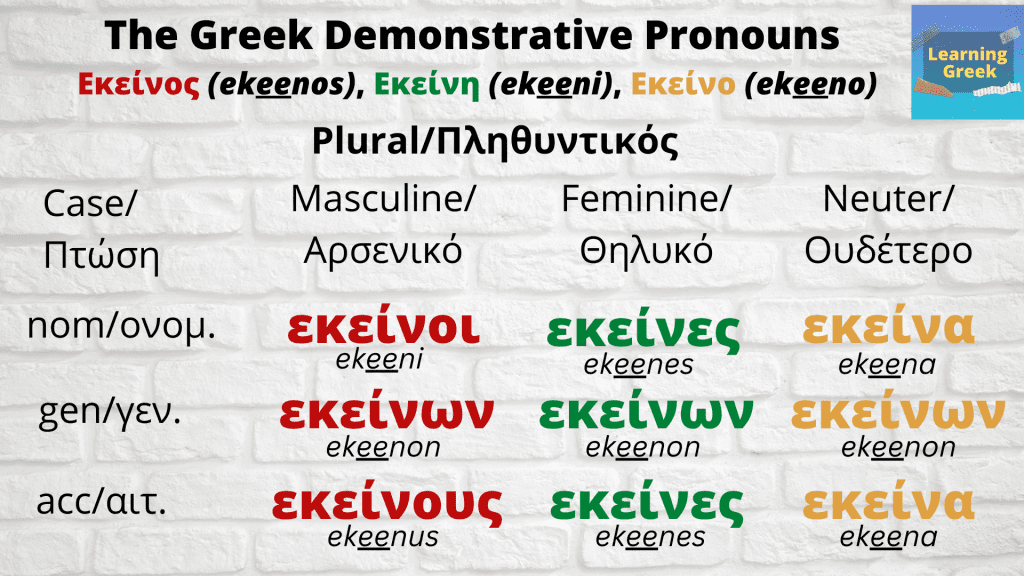
Declension of Greek Demonstrative Pronouns
In Greek, pronouns change form based on case, number, and gender. Below is a simple declension table for the singular and plural forms of these pronouns in the nominative, genitive, and accusative cases. It’s important to note that demonstrative pronouns like “εκείνος,” “εκείνη,” and “εκείνο” do not have a vocative case, as they are not typically used to directly address someone or something.

Usage in Context
These demonstrative pronouns are often used in Greek to clarify or emphasize a subject that has already been mentioned or is visible in the environment. They help distinguish between objects or people that are far away from the speaker.
Examples in Context:
1. Distinguishing Between Subjects:
- Ο αδελφός μου και εκείνος ο καθηγητής είναι και οι δύο πολύ έξυπνοι.
(O adelfos mu ki ekeenos o kathiyitis eene kai i dio polee eksipnee)
My brother and that professor are both very smart.
2. Emphasizing Distance:
- Θα προτιμούσα να πάρω εκείνο το αυτοκίνητο, όχι αυτό.
(Tha protimusa na paro ekeeno to aftokinito, ohi afto)
I would prefer to take that car, not this one.
3. Referring to Time:
- Εκείνη την ημέρα ήμουν πολύ κουρασμένος.
(Ekeeni tin imera imun polee kurasmenos)
That day, I was very tired.
4. Comparing Between Groups or Categories:
- Αυτοί οι πίνακες είναι ενδιαφέροντες, αλλά εκείνοι που είναι στο μουσείο είναι εκπληκτικοί.
(Afti i pinakes eene endiaferontes, alla ekeeni pu eene sto musio eene ekpliktiki)
These paintings are interesting, but those at the museum are amazing.
5. Specifying Locations:
- Εκείνα τα κτίρια βρίσκονται κοντά στον σταθμό του τρένου.
(Ekeena ta ktiria vriskonte konta ston stathmo tu trenu)
Those buildings are located near the train station.
6. Indicating Specific Items or People in a Discussion:
- Η γνώμη εκείνων των ανθρώπων είναι σημαντική για την απόφασή μας.
(I gnomi ekeenon ton anthropon eene simantikee yia tin apofasi mas)
The opinion of those people is important for our decision.
7. Pointing Out Specific Events or Moments:
- Εκείνο το γεγονός θα μείνει για πάντα χαραγμένο στη μνήμη μου.
(Ekeeno to yegonos tha minee yia panta charagmeno sti mnimi mu)
That event will remain etched in my mind forever.
8. Clarifying Preferences or Choices:
- Θα επιλέξω εκείνες τις καρέκλες για την τραπεζαρία.
(Tha epilexo ekeenes tis karekles yia tin trapezaria)
I will choose those chairs for the dining room.
Conclusion
The demonstrative pronouns εκείνος, εκείνη, and εκείνο are vital components of Greek grammar, allowing speakers to specify and distinguish between people, objects, or concepts that are more distant from the speaker. By understanding how to use these pronouns correctly and how they change with case and number, learners of Greek can greatly enhance their communication skills. Whether you’re pointing out a person across the room or referring to a memory from the past, these pronouns will help you articulate your thoughts clearly and precisely in Greek.
To fully grasp how Greek demonstrative pronouns function within sentences, it’s essential to understand Greek cases. If you’d like a simple and clear guide on Greek cases, check out this article.