
Hello, my enthusiastic Greek learner!
Today we’re going to learn the months in Greek. But is it essential to know the Greek months? You may ask. And yes, will be the answer.
When starting a new language, there are some groups of words that are absolutely necessary to learn, and the months along with the days, belong to this category.
At first glance, they may not seem so important to learn but you will be surprised as to how much they are used.
You cannot read a date without knowing the months for example. Or read a ticket or a sign.
The good news regarding the names of the Greek months is that they are very similar to the English ones.
This happens because they both follow the Gregorian calendar, like the rest of the western world, and derive from Latin.
So, it’s not so hard to remember them. But let’s go see them.
Months in Greek

The twist with Greek months is that most of them actually have two names. But don’t fret! Only their endings change (except from Ιανουάριος and Φεβρουάριος). The ending -ος can change to –ης.
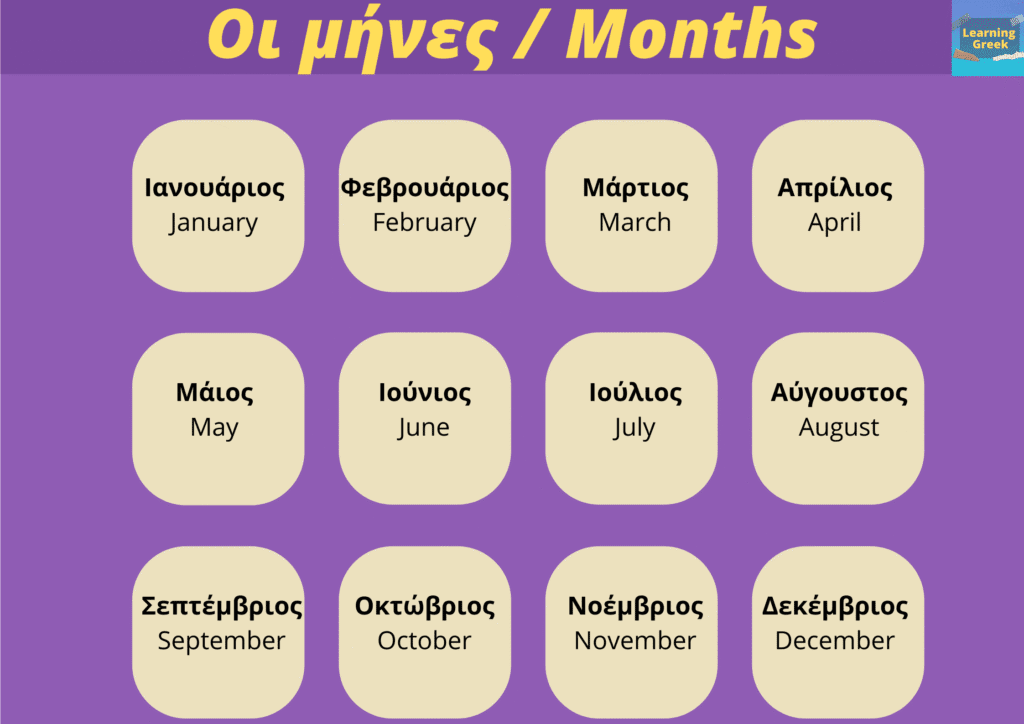
In the table below, you can see both of the forms of Greek months.
In bold letters, you can see the official name of each month.
If you’re wondering which form to use, we use both in everyday speech.
If you want to sound more formal, it’s better to use their official name, in bold.
It’s not necessary to learn both forms if it is too much for you right now. I wrote down both forms in case you bump into them in a text and you start asking yourself if what you see is written right or wrong.
Table of Months in Greek
| Months in Greek | Abbreviation | Pronunciation | Months in English |
|---|---|---|---|
| Ιανουάριος (Γενάρης) | Ιαν, Ι | Ianuarios (Yenaris) | January |
| Φεβρουάριος (Φλεβάρης) | Φεβ, Φ | Fevruarios (Flevaris) | February |
| Μάρτιος (Μάρτης) | Μαρ, Μ | Martios (Martis) | March |
| Απρίλιος (Απρίλης) | Απρ, Α | Aprilios (Aprilis) | April |
| Μάιος (Μάης) | Μάι, Μ | Maios (Mais) | May |
| Ιούνιος (Ιούνης) | Ιουν, Ι | Iunios (Iunis) | June |
| Ιούλιος (Ιούλης) | Ιουλ, Ι | Iulios (Iulis) | July |
| Αύγουστος | Αυγ, Α | Avgustos | August |
| Σεπτέμβριος (Σεπτέμβρης) | Σεπ, Σ | Septemvrios (Septemvris) | September |
| Οκτώβριος (Οκτώβρης) | Οκτ, Ο | Oktovrios (Oktovris) | October |
| Νοέμβριος (Νοέμβρης) | Νοε, Ν | Noemvrios (Noemvris) | November |
| Δεκέμβριος (Δεκέμβρης) | Δεκ, Δ | Dekemvrios (Dekemvris) | December |
Important notes
- Months are proper nouns and their first letter must always be capital.
- All months in Greek are masculine so they will need the “o” as an article and all of its types if it’s needed in a phrase. This is how they look with their article: Ο Ιανουάριος, ο Φεβρουάριος, ο Μάρτιος, ο Απρίλιος, ο Μάιος, ο Ιούνιος, ο Ιούλιος, ο Αύγουστος, ο Σεπτέμβριος, ο Οκτώβριος, ο Νοέμβριος, ο Δεκέμβριος.
But let’s move on to vocabulary now.
Vocabulary
- Ο μήνας (O minas) – The month
- Ο χρόνος (O hronos) – The year
- To έτος (Τo etos) – The year
- Οι μήνες του έτους/χρόνου (I mines tu hronu/etus) – The months of the year
- Τι μήνας είναι; (Ti minas ine;) – What month is it?
- Είναι… (Ine) – It is…
- Είναι Ιανουάριος (Ine Ianuarios) – It is January
- Είναι Φεβρουάριος (Ine Fevruarios) – It is February
- Τι μήνα έχουμε; (Ti mina ehume;) – What month do we have?
- Έχουμε… (Ehume) – We have…
- Έχουμε Μάρτιο (Ehume Martio) – We have March
- Πότε θα ανοίξουν τα σχολεία; (Pote tha aniksun ta sholia) – When will the schools open?
- Στις 15 Σεπτεμβρίου (Stis 15 Septemvriu) – At 15th of September
- Ποιο μήνα γεννήθηκες; (Pio mina yenithikes;) – Which month were you born?
- Γεννήθηκα τον Οκτώβριο (Yenithika ton Oktovrio) – I was born in October
It is very common for Greeks to wish each other every first of the month. They say:
- Καλό μήνα! (Kalo mina) – Have a nice month!
Well, that was it for today! It wasn’t so hard. Was it? I surely hope not.
Test Your Knowledge
But are you ready to see how much you’ve learned?
Take the Greek Months Quiz and see how well you know your Greek months!
Keep Learning Greek
If you enjoyed this lesson, continue your journey:
Days of the Week in Greek – Learn Greek weekdays, their meanings, and fun cultural facts.
Dates in Greek – Master how to ask and write dates like a native Greek speaker.
Seasons in Greek – Learn how to talk about the four seasons and weather expressions in Greek.
Happy learning!