
Numbers!
Numbers are everywhere. So, learning how to count in Greek will help you
in more ways than you can imagine. It’s not hard to learn the Greek
numbers. All you have to do, is learn how to count from 0 to 12 and then
the rest is easy. Trust me! Let’s go and see how to pronounce and write
the famous Greek numbers and how you can use them in everyday life.
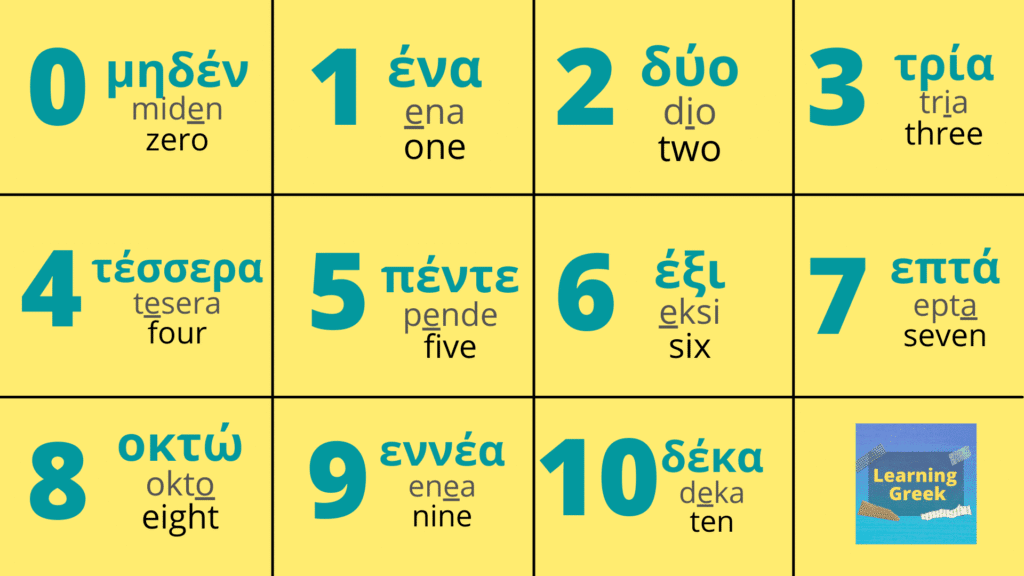
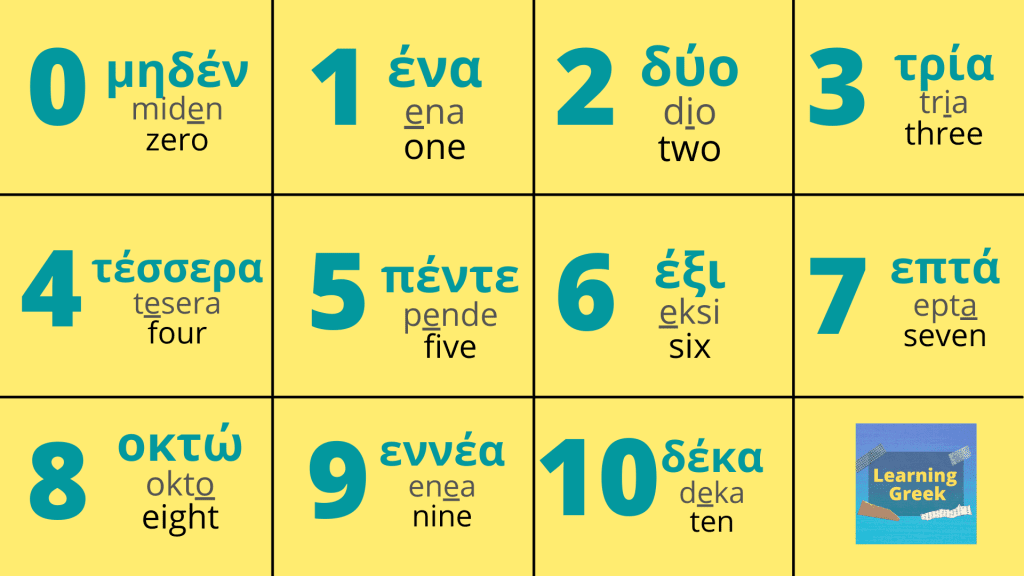
Greek numbers 0 – 10
These are the most vital numbers because they are unique and their
combinations will help you form all the other numbers from 13 and above.
If you learn them you are one step closer to learning all the Greek numbers.
Yep, all! So, let’s see them:
- 0 – μηδέν – (miden)
- 1 – ένα – (ena)
- 2 – δύο – (dio)
- 3 – τρία – (tria)
- 4 – τέσσερα – (tesera)
- 5 – πέντε – (pende)
- 6 – έξι – (eksi)
- 7 – επτά – (epta) or εφτά – (efta)
- 8 – οκτώ – (okto) or οχτώ – (ohto)
- 9 – εννέα – (enea) or εννιά – (enia)
- 10 – δέκα – (deka)
Greek numbers 11 – 20
There are two more unique numbers in the Greek number system, 11 and 12.
These are stand-alone unique numbers and they do not play part in
forming any other Greek like the other unique numbers just discussed. As
you will see below, from 13 and above the numbers are formed by using
the 10 (δέκα) plus one number from the above list.
- 11 – έντεκα – (endeka)
- 12 – δώδεκα – (dodeka)
- 13 – δεκατρία – (dekatria)
- 14 – δεκατέσσερα – (dekatesera)
- 15 – δεκαπέντε – (dekapende)
- 16 – δεκαέξι – (dekaexi)
- 17 – δεκαεπτά – (dekaepta)
- 18 – δεκαοκτώ – (dekaokto)
- 19 – δεκαεννέα – (dekaenea)
- 20 – είκοσι – (eikosi)
Note: All of the above numbers consist of one word
Greek numbers 21 – 100
Numbers from 21 and upwards are formed by using the following pattern.
The first number and it’s word refers to the multiple of 10 and the
second number and it’s word indicates the second digit of the whole
number. So the new thing you are learning now is how to write a whole
number using a multiple of 10 in combination with the unique number
range from 0 – 10.
Now, let’s seesome examples using some multiples of 10:
- 21 = 20 + 1 – είκοσι ένα – (eikosi ena)
- 22 = 20 + 2 – είκοσι δύο – (eikosi dio)
- 23 = 20 + 3 – είκοσι τρία – (eikosi tria)
- 32 = 30 + 2 – τριάντα δύο – (trianta dio)
- 43 = 40 + 3 – σαράντα τρία – (saranda tria)
- 56 = 50 + 6 – πενήντα έξι – (peninda eksi)
- 67 = 60 + 7 – εξήντα επτά – (eksinda epta)
- 78 = 70 + 8 – εβδομήντα οκτώ – (evdominda okto)
- 84 = 80 + 4 – ογδόντα τέσσερα – (ogdonda tesera)
- 99 = 90 + 9 – ενενήντα εννέα – (eneninda enea)
Note: Every number greater than 20 consists of two words
Greek Numbers which are multiples of 10
The Greek numbers which are multiples of 10 are listed below:
- 20 – είκοσι – (eikosi)
- 30 – τριάντα – (trianda)
- 40 – σαράντα – (saranda)
- 50 – πενήντα – (peninda)
- 60 – εξήντα – (eksinda)
- 70 – εβδομήντα – (evdominda)
- 80 – ογδόντα – (ogdonda)
- 90 – ενενήντα – (eneninda)
- 100 – εκατό – (ekato)
Greek Numbers 101 – 1000
As with the numbers 21 – 100 just discussed, the same pattern is used to
form numbers from 101 to 1000. The first digit changes and the rest
remain the same.
Let’s see some examples that will make this very clear:
- 251 = 200 + 50 + 1 – διακόσια πενήντα ένα – (diakosia peninda ena)
- 345 = 300 + 40 + 5 – τριακόσια σαράντα πέντε – (triakosia saranda pende)
- 789 = 700 + 80 + 9 – επτακόσια ογδόντα εννέα – (oktakosia ogdonda enea)
Important note: For numbers above 100 we include the final ν (n) when we
need to count using the 100.
Examples:
- 101 – εκατόν ένα – (ekaton ena)
- 102 – εκατόν δύο – (ekaton dio)
- 110 – εκατόν δέκα – (ekaton deka)
- 131 – εκατόν τριάντα ένα – (ekaton trianta ena)
Greek numbers which are multiples of 100
The Greek numbers which are multiples of 100 are listed below.
- 200 – διακόσια – (diakosia)
- 300 – τριακόσια – (triakosia)
- 400 – τετρακόσια – (tetrakosia)
- 500 – πεντακόσια – (pendakosia)
- 600 – εξακόσια – (exakosia)
- 700 – επτακόσια – (eptakosia)
- 800 – οκτακόσια – (oktakosia)
- 900 – εννιακόσια – (eniakosia)
- 1000 – χίλια – (hilia)
Multiples of 1000 and Greek Numbers 1001 – 1000000
We have already seen that 1000 in Greek is χίλια (hilia). But, we use the
word χιλιάδες (hiliades) when we want to count from 2000 until
999000 and we follow the same pattern as before until we reach the
1000000 which is called εκατομμύριο (ekatomeerio). Due to the fact
that the word χιλιάδες (hiliades) is feminine, we use the feminine
cardinal to indicate that number.
These examples will illustrate the point:
- 1000 – χίλια – (hilia)
- 1003 – χίλια τρία – (hilia tria)
- 1567 – χίλια πεντακόσια εξήντα επτά – (hilia pendakosia eksinda epta)
- 2000 – δύο χιλιάδες – (dio hiliades)
- 3000 – τρεις χιλιάδες – (tris hiliades)
- 4000 – τέσσερις χιλιάδες – (tesseris hiliades)
- 5000 – πέντε χιλιάδες – (pende hiliades)
- 10000 – δέκα χιλιάδες – (deka hiliades)
- 500000 – πεντακόσιες χιλιάδες – (pendakosies hiliades)
- 678000 – εξακόσιες εβδομήντα οκτώ χιλιάδες – (eksakosies evdominda okto hiliades)
- 1000000 – ένα εκατομμύριο – (ena ekatomirio)
That wasn’t so hard, was it? I hope not 🙂
Learning Greek on You Tube
If you want to hear the pronunciation of numbers 1-10 you can watch my
short and sweet video on You Tube. Enjoy!
And if you want to test your knowledge of Greek numbers, brace yourself
and take the Greek Numbers Quiz. Then, deepen your understanding by
exploring how to form and use Cardinal and Ordinal Numbers in Greek.
Take care!