
Think you know your Greek? Read it in Greek here: Ροδώπις – η Αρχαία Ελληνική Σταχτοπούτα
Almost all of us know the story of Cinderella as presented to us in 1697 by the
French author Charles Perrault through his book ” Mother Goose Tales ” ( Contes
de ma mère l’Oye) or as we met her through the fairy tales of the Brothers
Grimm published in 1812. But how many of us know the ancient history of
Rhodopis, a Greek slave who married the king of Egypt and has many similarities
with our famous Cinderella?
Herodotus’ version
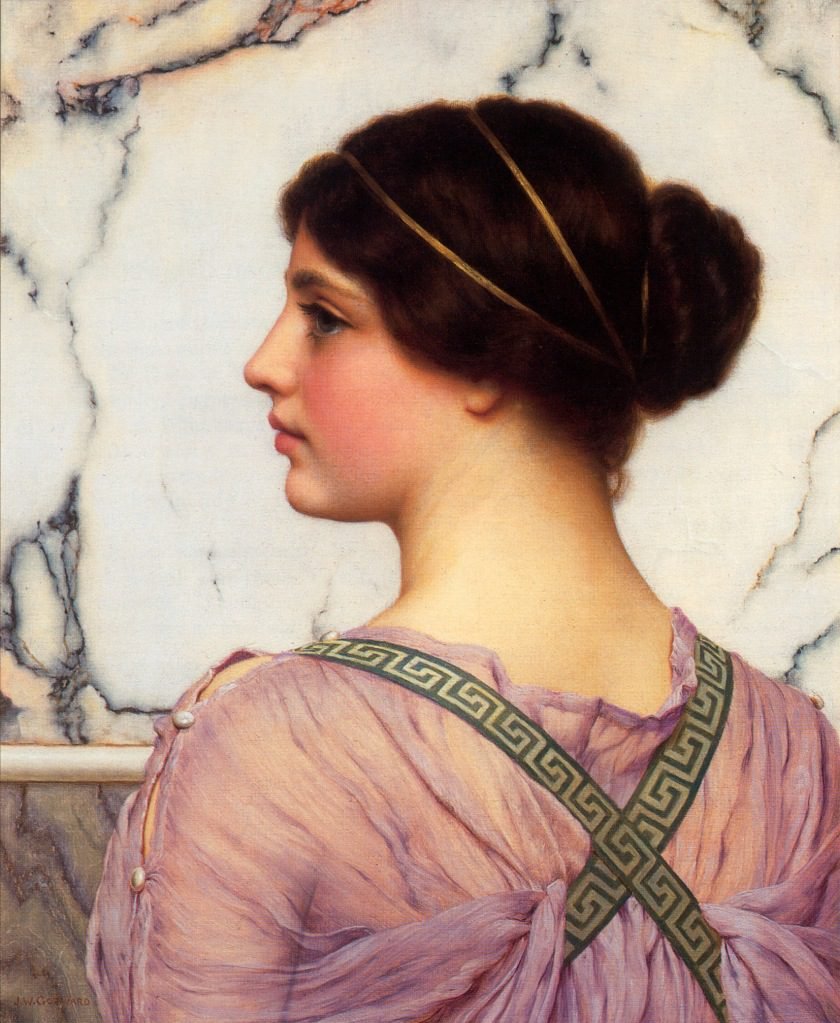
The story of Rhodopis, which means rosy cheeks, is first told to us by Herodotus
in his 2nd volume of his book “The Histories” written around 431 BC. According
to Herodotus, Rhodopis was a beautiful girl from Thrace, a region of Northern
Greece and was a slave of Iadmon from Samos and a fellow slave of Aesop, the
famous storyteller. Aesop himself makes a brief reference to her story and even
states that he had met her personally and had told her many of his stories.
Later, she became a slave of Xanthis who was also from Samos and he took her
to Naucratis, a Greek city in Egypt. There she met Haraxos, the brother of the
famous poet Sappho who fell in love with her and set her free for a very large
sum of money . Haraxos returned to Lesvos while Rhodopi continued to live in
Naucratis and thanks to her beauty she managed to raise a lot of money. From
the money she raised and her desire to leave something that she will be
remembered for in Greece, she built a monument in Delphi. And this is the end
of Herodotus’ story.
I guess you will wonder about the resemblance with Cinderella and you will not
be wrong. Let’s move forward in the timeline and see what happens next. For
the next 400 years, Rhodopis’ name is not mentioned in any source.
Strabo’s version
Strabo, a Greek historian, philosopher and geographer from Amasya of Pontus,
mentions her in his book “Geographica” written between 7 BC and 24 AD.
Strabo’s story is also the first version of Cinderella as we know it today. In the
description of Strabo, we find many similarities with that of Herodotus. So we
can conclude that Strabo had Herodotus as his source. However, Strabo gives
us a version that we do not find in Herodotus.
According to Strabo, Rhodopis was born in Greece but she was abducted by
pirates who sold her as a slave in Egypt. Her master was a good man and
appreciated her. He had even given her a beautiful pair of sandals. However,
he did not pay much attention to what was happeningin his house and slept
most of the day. So, the other slaves who were jealous of her, found an
opportunity to burden her with a heavy workload.
One day, while Rhodopis was bathing or washing her clothes in the river, an eagle
appeared and snatched one of her sandals that she had left in the sun to dry. He
carried it far to another city in Egypt, Memphis, and let it fall at the feet of the
Pharaoh, while he was administering justice out in the countryside. Pharaoh,
astonished but also impressed by both the elegance of the sandal and the
strangeness of the event, considered it a divine sign. He immediately sent his
men all over the country to look for the owner of the sandal.
When they find Rhodopis in the city of Naucratis, they immediately take her to
the Pharao in Memphis. Pharaoh, impressed by her beauty, made her his wife
and Queen of Egypt.
Conclusion
So we find that there are many similarities in the history of Rhodopis as told by
Strabo, with that of Cinderella. A beautiful girl loses her shoe. A king finds it and
looks for its owner. Once he finds her, he marries her.
The myth of Cinderella in all of its versions remains timeless throughout the
centuries. This is proven by the reference of two non contemporary Greek
authors in classical antiquity plus the history of Cinderella as we know it today.
Rhodopis on YouTube
You can also watch Rhodopis’ story on YouTube.
Audio is in slow Greek with English subtitles.
Want to challenge your Greek? Check out the Greek version: Ροδώπις – η Αρχαία Ελληνική Σταχτοπούτα