
Hey there, amazing learners of Greek!
Today, let’s dive into the fascinating world of Greek homophones. Those tricky little words that sound the same but have totally different meanings!
Greek is filled with these gems, and once you get the hang of them, you’ll find them endlessly interesting and, dare I say, a little bit fun.
So if you’re ready to level up your Greek vocabulary and avoid a few hilarious misunderstandings, let’s get started!
What Exactly Are Homophones?
Homophones are words that share the same pronunciation but have different meanings (and may also be spelled differently). Greek, with its rich history and many vowel sounds that have converged over time, is full of these homophones. When spoken, they sound identical, but context and sometimes a little help from accent marks will reveal their true meanings.
So, if you’re learning Greek or just curious, these are some essential words to know. Let’s take a closer look at some of the most common Greek homophones, along with how to use them!
Greek Homophones
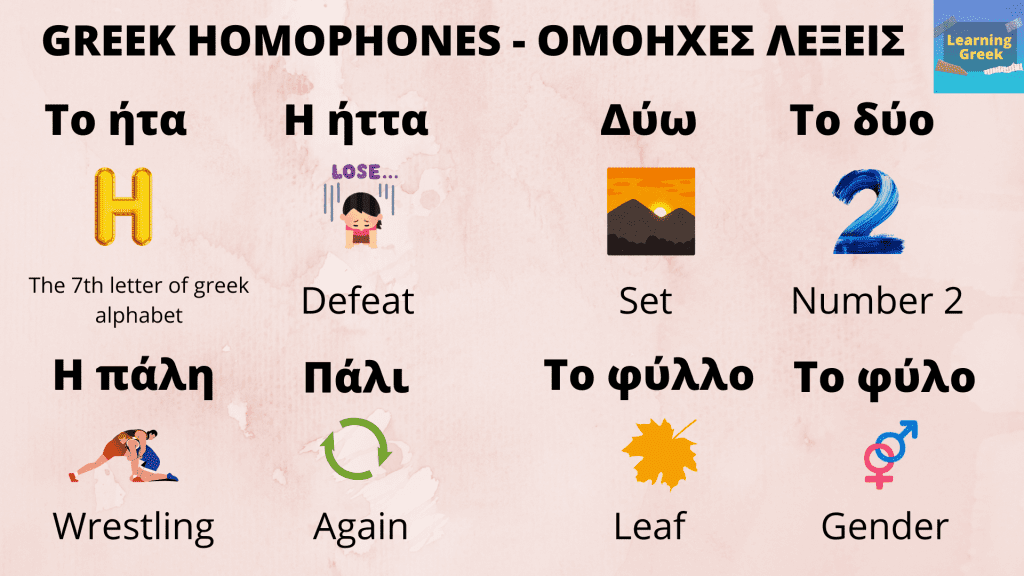
1. Ήτα (íta) vs. Ήττα (íta)
Here’s a homophone that looks deceptively similar but means completely different things!
- Ήτα (íta): This is the name of the letter “Η” in the Greek alphabet. If you’re talking about letters, this is the one you’ll use. For example, το γράμμα ήτα (to grámma íta) means “the letter eta.”
- Ήττα (íta): This means “defeat.” So if you’re talking about losing a game, you might say, υπέστη ήττα (ypésti íta), which means “suffered a defeat.”
One little letter makes all the difference between a letter of the alphabet and a tough loss!
2. Δύο (dίο) vs. Δύω (dίο)
These two words sound the same but have very different meanings:
- Δύο (dίo): This is the number “two.” So if you’re counting, δύο μήλα (dýo míla) means “two apples.”
- Δύω (dίo): This is an old-fashioned or poetic verb meaning “to set” (like the sun setting) or “to plunge.” For instance, in poetic language, ο ήλιος δύει (o ílios dýei) means “the sun sets.”
This pair reminds us that even familiar numbers can carry other meanings in the right context!
3. Πάλη (páli) vs. Πάλι (páli)
Here’s one you’ll hear a lot in everyday conversations!
- Πάλη (páli): This word means “wrestling” or “struggle.” For example, η πάλη των τάξεων (i páli ton táxeon) means “the class struggle.”
- Πάλι (páli): This one means “again.” So if something happens one more time, you’ll say πάλι (páli). For example, πάλι καλά! (páli kalá!) means something like “thank goodness!” or “at least!”
These two sound identical, but they lead to very different conversations depending on whether you’re talking about struggles or something happening again!
4. Φύλλο (fίlo) vs. Φύλο (fίlo)
These two are true classics in Greek homophones!
- Φύλλο (fίlo): This word means “leaf,” as in a leaf on a tree. It’s also used to refer to thin sheets, like φύλλο κρούστας (fýllo kroústas) for “phyllo dough.”
- Φύλο (fίlo): This word has two main meanings: “gender” and “species.” So, το φύλο του (to fίlo tou) can mean “his gender,” while ανθρώπινο φύλο (anthrópino fίlo) means “human species.”
These two are easy to mix up, especially in writing, but they’ll take you to very different topics in conversation!
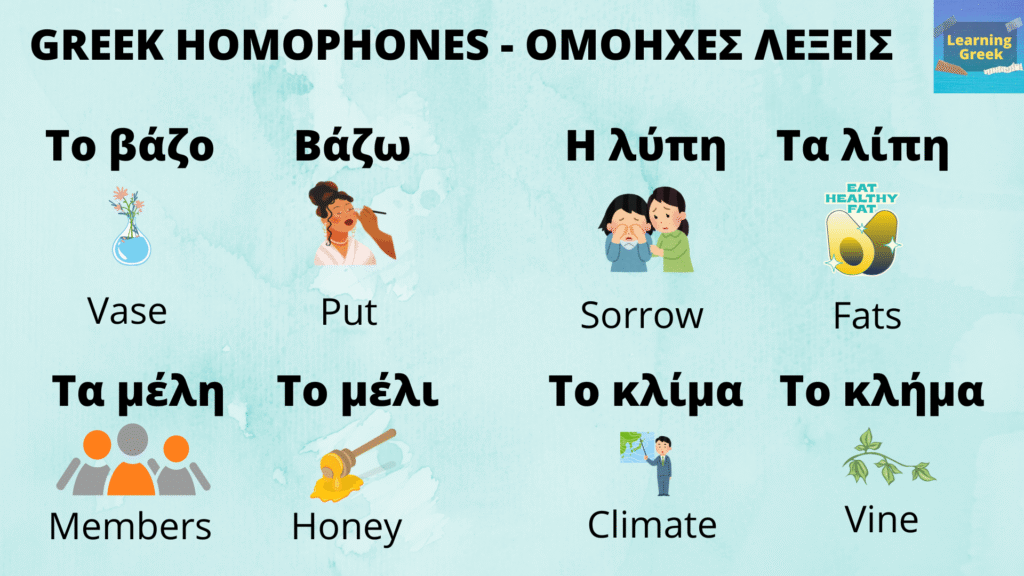
5. Βάζο (vázo) vs. Βάζω (vázo)
A simple spelling tweak can make all the difference with this pair!
- Βάζο (vázo): This is the noun for “jar” or “vase.” So if you’re talking about flowers, βάζο (vázo) is the word you want. For example, ένα βάζο με λουλούδια (éna vázo me louloudia) means “a vase with flowers.”
- Βάζω (vázo): This is a verb meaning “I put” or “I place.” For instance, βάζω το βιβλίο στο τραπέζι (vázo to vivlío sto trapézi) means “I put the book on the table.”
One tiny vowel completely changes this word from an object you put things into, to the action of putting something somewhere!

6. Λύπη (lípi) vs. Λίπη (lípi)
- Λύπη (lípi): This word means “sadness” or “sorrow.” For example, νιώθω λύπη (niótho lípi) means “I feel sadness.”
- Λίπη (lípi): This is the plural form of “fat” (lipids), used in a nutritional or scientific context. Τα λίπη στη διατροφή (Ta lípi sti diatrofí) means “the fats in the diet.”
A little difference in spelling, but they talk about very different things. Emotions versus nutrition!
7. Μέλη (méli) vs. Μέλι (méli)
- Μέλη (méli): This word is the plural form of “member” and means “members,” referring to individuals belonging to a group or organization. For example, είμαστε μέλη της ομάδας (eímaste méli tis omádas) means “We are members of the team.” It can also refer to “limbs” or “parts” of the human body.
- Μέλι (méli): This remains unchanged in meaning and still refers to “honey.” For instance, μας αρέσει το μέλι (mas arései to méli) means “We like honey.”
8. Κλίμα (klíma) vs. Κλήμα (klíma)
- Κλίμα (klíma): This word means “climate” or “environment.” It is used to describe the general weather patterns of a region, as well as metaphorically to describe an atmosphere or mood. For example, Το κλίμα στην Ελλάδα είναι μεσογειακό. (To klíma stin Elláda eínai mesoyeiakó) – “The climate in Greece is Mediterranean.”
- Κλήμα (klíma): This word means “vine” or “grapevine.” It is commonly used to refer to the grapevine plant, which produces grapes. Example, Τα φύλλα του κλήματος χρησιμοποιούνται στη μαγειρική. (Ta fýlla tou klímatos hrisimopoiúntai sti magirikí) – “The leaves of the grapevine are used in cooking.”
Despite sounding the same, κλίμα and κλήμα take you into very different topics, whether it’s discussing the weather or agriculture! These homophones are a perfect example of how one sound can carry multiple meanings in Greek, adding richness to the language.
Greek Homophones: A Fun Language Twist!
Greek homophones are charming little puzzles that make learning the language exciting. They illustrate how context matters, whether you’re talking about a “vine” or “climate,” or deciding between “member” and “honey.” So next time you’re speaking Greek, listen for those subtle differences and enjoy the laughter from any mix-ups. Greeks will appreciate your effort!
These playful words often lead to humorous moments in conversation. To explore the lighthearted side of Greek language, check out my article on Greek humor with homophones and discover how these linguistic quirks can create funny misunderstandings!